Showing posts with label recipes - mains - meat. Show all posts

Sunday, August 14, 2005

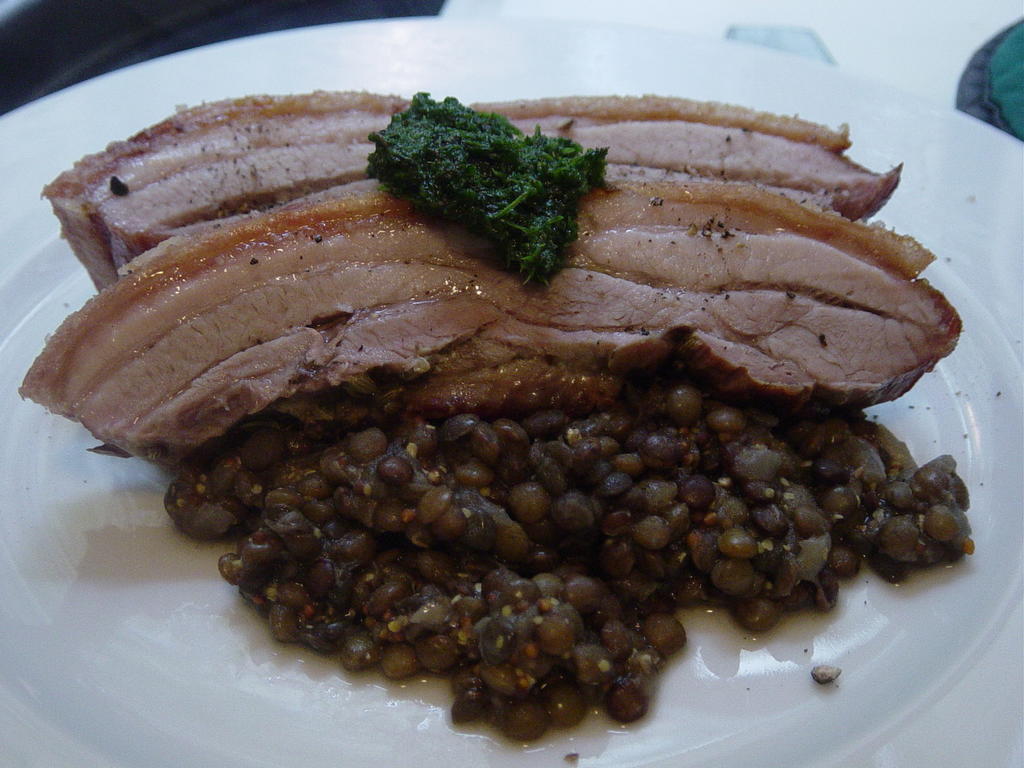
End of Term 1: Crispy Pork with Fennel and Mustard Lentils

Crispy Pork Belly with Fennel and Mustard Lentils


OK, the whole “learning to cook by being married to a cook and loitering” thing has always been a serious objective for me. Nevertheless I always thought that the teaching staff (Blanca) lacked a certain amount of dedication and conviction… there was never much structure. This weekend that all changed, I’m fearful of the consequences...

Blanca returned from a week in Spain full of fascist fervour. She directly set to assessing how I had coped in the kitchen during her week away. The “Home Alone” series of blogs was used as documented proof of how I had fared. After all these months of love and care, the blog was turned against me.

So, it seems that there was an invisible hand directing most of my efforts over the past few months. The logic was revealed to me yesterday over a morning coffee…

Term 1 (basic), as this period will forever be known, with some of the following "highlights":
- chopping
- pastry
- creaming method
- fish work
- risotto and plant starch

In the end things were ok; I got a B+ for the whole term. I got special praise for my unashamed geekiness and knife skills. My seasoning, lack of comments and annoying questions require improvement. There was no report card or end of term party (apparently Blanca’s school is working on a bit of a shoestring budget)…

We are now entering Term 2 (intermediate), it will be challenging, with the following highlights:
- soufflé
- paella
- French onion soup
- Genoise
- Pasta making
- Choux pastry
- Sauté cut chicken
- French stew

The Term 3 (advanced) syllabus seems to be a little up in the air, but will contain:
- puffed pastry
- beef Wellington

To celebrate the end of term (and relieve a week old pork belly from its misery), we cooked pork belly and mustard lentils today. Fittingly, this earthy recipe comes from the Books for Cooks vol. 6.

For the pork:
1 tbsp fennel seeds
2 garlic cloves, chopped
1 kg pork belly in one piece, skin on and scored
1 tbsp salt

For the lentils:
1 tbsp olive oil
1 large onion, chopped
4 garlic cloves, sliced
350 g puy lentils
4 tbsp Dijon mustard
salt and pepper

For the salsa:
2 tbsp flat-leaf parsley
2 garlic cloves
Olive oil
salt and pepper

Press the fennel and garlic on the flesh side of the pork. Place in a baking tray, skin side up. Dry the scored side and sprinkle salt evenly over the surface. Leave to stand for half an hour.

Heat the oven to 220 C. Roast the pork for half an hour, turn down to 180 C and bake a further hour and a half. Remove from the oven and let stand for 5 minutes before carving.
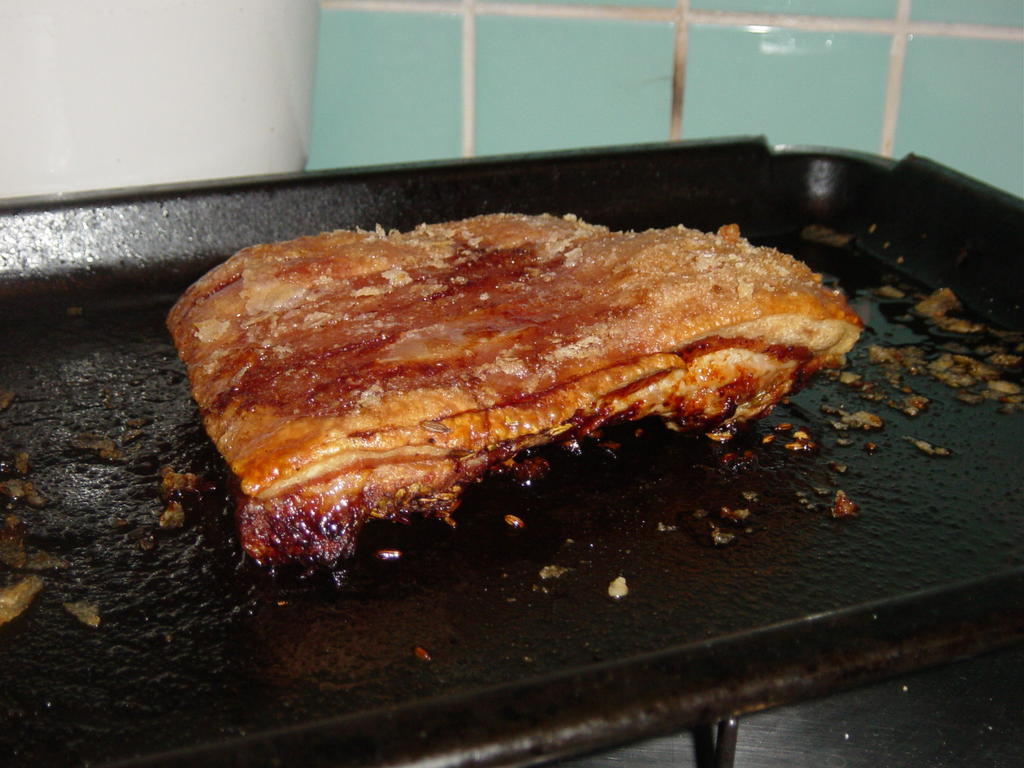

Cook the lentil while the pork is in the oven. Warm the oil, add the onion and garlic and stir until the onion has softened (approx 5 mins). Add lentils and cover with boiling water. Put the lid and simmer steadily. Cook for about 50 minutes when the lentils are soft and thick. Add water as it dries out. Stir in mustard and season to taste.
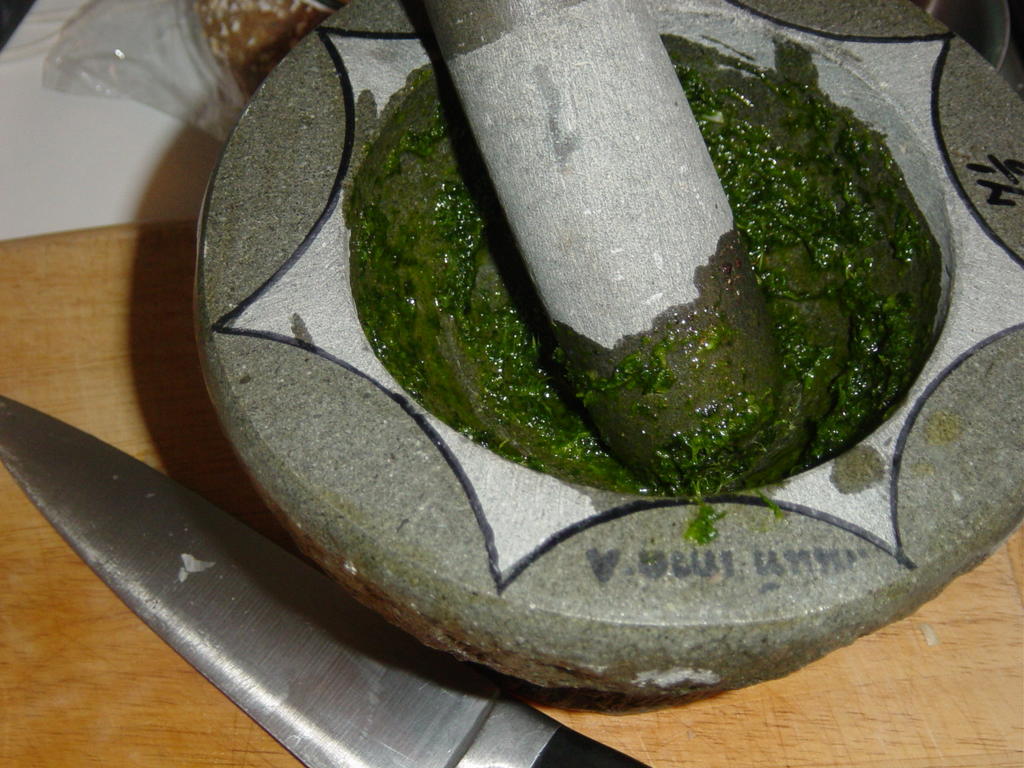

Grind the parsley and garlic in a pestle and mortar. Add the olive oil until it reaches a salsa constituency. Season according to taste.

Plate the lentils and lay over strips of pork, topped by parsley salsa.

See you next term…

Technorati Tags:

Tuesday, March 22, 2005

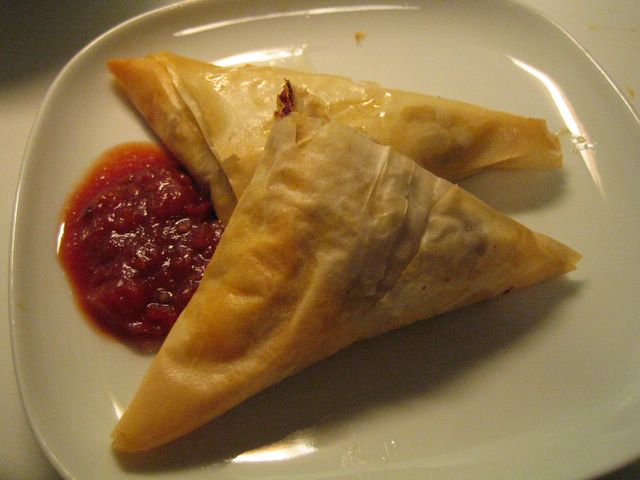
minced lamb parcels with pinenuts

minced lamb parcels with pinenuts


i don't know how the other bloggers do it. between looking after the kids, the local scout troop, delivering meals on wheels and my 3 golden retrievers, i sometimes find it difficult to get time to write up my blogs. ok, i don't have the kids, scouts, wheels or even the dogs, but i am finding myself being weighed down by a few blogs that are queuing up to be written and posted. as a result, this is gonna be a little brief and to the point ...

cooking from the raunchily named "tarts with tops on" (originally from claudia roden's "the book of jewish cooking"), today we prepared some lamb phyllo pastries.

ingredients: minced lamb for 2, tomato, courgette, onion 1/2, pinenuts, all spice, cinnamon, phyllo pastry, butter, salt, pepper

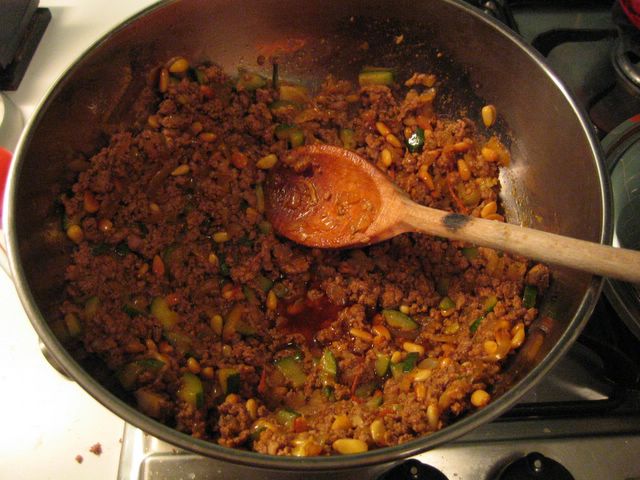
brown the lamb whilst cutting the vegetables finely (dice). note: today i learnt the difference, much to my chagrin, between slicing and dicing ... dicing is cutting small and slicing is in cutting circles (more or less). when browned, remove the lamb into a bowl. add the tomato, courgette and onion to make a sufrito. add spice, cinnamon, salt and pepper to flavour. there was a minor breakthrough today in that i did know that the sufrito was under flavoured ... i'm learning. put the mince back in and mix / flavour. leave the mixture to cool. it is incredible, but this smell triggered a complete food memory for me ~ shwarma. the pastry has strong greek and middle eastern tradition so there could be something in that ...


sufrito ... with spoon and minced lamb


today was the first time for me to use phyllo pastry as part of the course. we cheated and used premade, but i promise to add to my shortcrust science lesson and make some phyllo very soon. what i do know about it; it is the greek for leaf and can be spelt as phyllo (basically any cookbook ensuring that you can't find it) or filo (any premade pastry ensuring that you can't find them). a trick that blanca taught me; wrap the filo in a towel while you are not using it in order to ensure that it does not dry out.

preheat the oven to 170c. when you're ready to eat, cut a square (note, this is an unorthodox technique ~ you may be better following below) of the phyllo. brush melted butter to the edges of the pastry. place the mixture and fold around. at this point it is best not to have a specific shape in mind ... start folding, then become painfully aware that you are holding the equivalent of pastry gold in your hands that can rip and dry out literally any second. start to panic and just wrap the pastry in whatever shape that it will go into that will not send diners running for miles ...

cook for approx 8 minutes until golden brown and serve to horrified guests.

on take 2 we consulted the web: http://www.cs.unc.edu/~barman/filo.html
. thank you dilip - your masterful photos and drawings saved my dinner and probably mean that i will persevere into writing a blog another day ... follow the ribbon, fold technique to produce good looking triangle shaped pastries.


ribbon of pastry with lamb ready for rolling ...

as it happens, not only did i buy premade pastry, but i also bought pastry that has pictures on the back of the carton of how to fold the triangles ... you can bring a cook to water, but you can't make him fold proper triangles ...

Saturday, March 05, 2005

classic cottage pie

classic cottage pie

now that i'm officially trying to learn how to cook, it seems that formerly simple dishes have taken on cosmic complexities that i had not anticipated. today we made a classic cottage pie. i call this classic in an effort to emphasis to you that there was nothing special about this - it was supposed to be very simple ... i suppose it's my fault for not calling it simple cottage pie ...

ingredients: carrots, celery, onion, oil, salt, pepper, water, oregano, parsley, minced beef steak, potatoes, sweet potatoes, tomatoe puree, worcester sauce and parmesan.

the cooking was really characterised by a number of mistakes and faux pas ... in order to save you the embarrassment of an anecdote, i will simply state the 5 core rules of classic cottage pie (ccp) ...

ccp rule 1: in order to sweat the (XXX) you must cut all in similar sizes to ensure that they cook at the same speed and evenly. i am now beginning to use the half onion cut / fingers and chop as i'm going to patent it ... although, i'm not sure i like the sound of fingers and chop in the same name. delia has described this technique far better than i could, albeit without the intimidating name: http://www.deliaonline.com/cookeryschool/howto/how_0000000065.asp.

ccp rule 1.1: cooking is all about the flavour of your sweating. ok, this is a little crude, but the theory as it is explained to me goes that the most important ingredient is a simple sweating of onions, carrots and celery (a combination that is often called mirepoix from the c18 chef of the duc de levis-mirepoix in france). it can be used to flavour soups, stews, stocks, risottos and the odd devious pie etc. the process gets its name from the fact that the vegetables "give off" their water, it is designed to cook and concentrate the juices of vegetables. the sweating can be accelerated at the beginning with the addition of water (this will produce a purer taste than oil) and the lid placed on the pan. subsequently wine can be added for flavouring. i'm going to start counting how many meals in the future have this component and award honourable service prizes to vegetables and water as appropriate. please don't confuse this technique with the other technique that i adopt with alarming frequency when in the kitchen in which i also "give off" water.

ccp rule 2: add salt to the vegetables to draw the water out of the cooking. i'm obviously still learning about the role of salt in flavouring, it appears there is another purpose that the mineral serves during cooking vegetables. salt will draw the water from the vegetables while they are cooking. this will give a richer flavour to the food. interesting facts and reading about my problematic friend: http://www.foodsubs.com/Salt.html.

ccp rule 3: cook root vegetables in boiling water from cold. now, this one is a little controversial. i had blindly accepted this as i related to it from childhood, but it appears there is some debate on the correct way to boil a root vegetable. the debate focuses on how the starch (carb) reacts to the boiling water. the process of boiling means the water is absorbed into the starch and it gelatinises (softens and hence feels cooked). in this matter, i am going to let jeffrey steingarten (the man who ate everything) have the final say; he feels that peeled and washed (to remove free starch) potatoes should be placed into 175-degree water and maintained at approx 160 through the gradual addition of cold water. this produces better cooked potatoes and in fact has been shown to retain a higher amount of vitamin C (i'm sure in equal and opposite portions to free time) ..

ccp rule 4: don't add salt to your potatoes while in water - wait until after. jeffrey agrees with this approach, he rather vaguely mentions that an odd flavour can develop if cooked with salt (?!).

ccp rule 5: don't bang the wooden spoon off the side of the pot - it scratches the bottom. yeah, yeah ... but someone is getting too sensitive about pots and pans.

the rest of the ccp is pretty simple - cook for about 30 minutes until the top is nicely golden.

i never thought i'd say this, but i found a great page on onions: http://specialflavors.com/collection/vegetables/onions.htm

mr steingarten is part of my course mandatory reading and can be found at: http://www.randomhouse.com/knopf/catalog/results2.pperl?authorid=29672