I haven't blogged in about 3 years... must be that Japan inspired something in me, or maybe it's true what they said all along - blogs are for geeks...
Either way, I happend to check my spam (blog) email the other day and was happy to see that "To Japan with Love" has been published... I think this is after about 4 or 5 years in preparation - that's one aspect that blogs have the advantage over books...
Nice to see a few of my Japan articles in print... capsule hotels in Osaka, karei raisu and maratakaya (ramen in Toyama) all got the nod... on that basis alone, it must be a very good book.
Showing posts with label travel - japan. Show all posts
Showing posts with label travel - japan. Show all posts
Sunday, January 17, 2010

Thursday, June 30, 2005
Sansho & Fate
There is a word for the situation whereby something stumbled across for the first time appears on a seemingly frequent basis thereafter. I can't remember it. I will call it "sansho".
Sansho is the name of the herb pepper that we had with Unagi recently ... later, that same day, across the other side of town we came across a sprig of the original - from the kinome shrub.
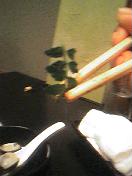
As if in a scene from a culinary Yimou Zhang movie, the kinome sprig is caught midair by the deft hand movement of Steve's dining companion ...
A little bit more digging revealed that the kinome shrub actually produces szechuan peppercorns (these are the shells surrounding the seeds). The uwajimaya site explains the taste as "being reminiscent of mint, basil with a hint of anise" - I would say more than a hint. It also reckons that the pepper has a lemon-like flavour.
That's sansho for you!
p.s. if anyone knows the name for the sensation mentioned in the first line, please mail me...
Sansho is the name of the herb pepper that we had with Unagi recently ... later, that same day, across the other side of town we came across a sprig of the original - from the kinome shrub.
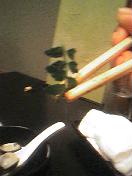
As if in a scene from a culinary Yimou Zhang movie, the kinome sprig is caught midair by the deft hand movement of Steve's dining companion ...
A little bit more digging revealed that the kinome shrub actually produces szechuan peppercorns (these are the shells surrounding the seeds). The uwajimaya site explains the taste as "being reminiscent of mint, basil with a hint of anise" - I would say more than a hint. It also reckons that the pepper has a lemon-like flavour.
That's sansho for you!
p.s. if anyone knows the name for the sensation mentioned in the first line, please mail me...
Tuesday, June 28, 2005
inagi, unagi ... we all nagi
It’s hot in tokyo today. 88 degrees F with 58% relative humidity. The heat index is at 94f (10 degrees away from a dog heat stoke). We decided to shelter our meteorologically fixated minds in an unagi (eel) restaurant.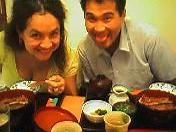
Although eel does not feature on the world’s healthiest foods site, it is regarded as summertime healthy in Japan. Three reasons abound:
- It is a good source of protein, calcium and vitamins A and E.
- Less scientific, but far more romantic, lore has it that eels are strong in order to make the journey from ocean upriver in order to breed – the things we do.
- Either way, it is thought to improve stamina and as a result it is most often eaten at the hottest times of the year. In fact, doyo-no-ushi (complicated, but something like 18 days before fall) is the day that the japanese traditionally eat eel. On this day food beginning with “U” is considered good for our health (ok, the least scientific of all reasons).
Grilled eel is a specialty in Japan. We didn’t see the cooking, but it seems to consist of 3 stages – over charcoal, steamed to remove fat and finally seasoned and grilled. We went for the typical unajuu or unagi donburi or unadon (basically anything you want). It is served on a bed of rice with teriyaki sauce over the fish. Much like the 4 steps to happiness that cocoichibanya recommend, the waitress recommended an interesting 3 styles to eating the unagi (she may have been getting revenge for having to cook the thing in 3 different ways):
Style 1: unagi with sansho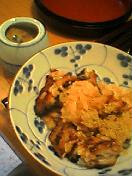
Actually, we didn’t know what sansho was. Thoughts ranged from fish salt to herbs. It turns out to be a powdered aromatic pepper.
Style 2: unagi with onions, seaweed and wasabi
Not the best photo that was ever taken in Japan, but this was my favourite (syle not photo).
Style 3: unagi soup
Disturbingly enough Taro called this tea.
Friday, June 24, 2005
Tsukiji Cart Racing
Ever since my first visit to Japan back in October, I’ve wanted to get to see the famous fish market; Tsukiji. The hours of business (5am to 9am) have mostly precluded any visits. We were fortunate that a recent world cup qualifier (Japan vs. Bahrain) ran until 3am. A quick detour for Karaoke in Roppongi meant that we arrived at the market at about 6am … the sacrifices we make for our food!
The central wholesale market is the largest in Japan. It is a market for all food related products; fish, fruit, vegetables and kitchen utensils, but it is most famous for its fish. It is located in central Tokyo. It is one of the world’s largest and handles over 2,000 tons of fish everyday. Note: there seems to be some debate as to the largest in the world, we have given the award to Tsukiji. Fish comes off trawlers directly to the market and is sold out to the restaurants for the day’s dining.
Admittedly the timing may not have been best to capture the full culinary delights of the market. Nevertheless the alcohol in our veins made the adventure suitably surreal. A warning on the Japan guide website states that it “is a site where serious business is conducted, it is important for visitors not to interfere with the action by not bringing any large bags and not obstructing traffic along the narrow lanes”. The sight of 4 karaoke revellers weaving through the narrow lanes and dodging the trucks was probably not the most welcome to the local tradesmen. It was a good job that we didn’t read this prior to our trip. Being forewarned would have inevitably meant that we would have been far more likely to be injured.

Trucks at Tsukiji – courtesy of japan-guide. I would have taken a photo myself, but for the rush that I was in to safety.
We spent some time moving from stall to stall. I managed to buy a Japanese mandolin (the slicing kind) and tacky sushi teacup … you know, the typical drunken purchases you make a large fish markets. Taya had her photo taken with a bear while Taro and Matt played chicken with the Tsukiji carts. The trip reads like a hallucinogenic fantasy. The carts are fantastic; alone worth the visit. There is a junction in the middle of the market where all the local tradesmen seem to congregate in order to race each other. There are no traffic lights. Crossing this junction on foot feels like walking in between burning oil cans being wielded by demented tramps … with 2,000 tons of fish on their backs.
The revelation of the trip was the tuna. Although we didn’t get to see the tuna market (it is off bounds for tourists at this time of the year – thank god!). We did manage to see into the cargo-in bay from a safe distance. Blue Fin Tuna will grow to approximately 6 ft (2 m) and weigh about 300 lb (135 kg). It can live up to 40 years, but is mature at 8. They can be found in both the Atlantic and Pacific in waters as deep as 3000 feet. The can swim at up to 45 mph, meaning that they could cross the Atlantic in 60 days. The meat is prized and can sell for as much as $30,000 for a large fish.

Frozen tuna being slides – courtesy of Wikipedia.
There are many interesting facts about tuna (courtesy of wikipedia). It is one of the few fish that is warm blooded. Most fish are cold blooded and as assume the temperature of the water surrounding. This gives them very little range in terms of their ability to travel. Tuna has a higher oxygen carrying ability than any other fish species. As a result, the flesh of tuna is pink (unlike most white flesh ocean fish). Bluefin can use muscle activity to actually increase their body temperature above the surrounding waters.
We had what is rumoured to be the best sushi in Tokyo; breakfast at the market. For 600 Yen I had fantastic tuna steak with tea. At this point we were all beginning to feel a little worse for wear by the end and decided to leave at about 8am.

The parting shot – leaving the market with shopping and heads in our hands. This is the only photo we managed to take (at least that I'm allowed show) ...
The central wholesale market is the largest in Japan. It is a market for all food related products; fish, fruit, vegetables and kitchen utensils, but it is most famous for its fish. It is located in central Tokyo. It is one of the world’s largest and handles over 2,000 tons of fish everyday. Note: there seems to be some debate as to the largest in the world, we have given the award to Tsukiji. Fish comes off trawlers directly to the market and is sold out to the restaurants for the day’s dining.
Admittedly the timing may not have been best to capture the full culinary delights of the market. Nevertheless the alcohol in our veins made the adventure suitably surreal. A warning on the Japan guide website states that it “is a site where serious business is conducted, it is important for visitors not to interfere with the action by not bringing any large bags and not obstructing traffic along the narrow lanes”. The sight of 4 karaoke revellers weaving through the narrow lanes and dodging the trucks was probably not the most welcome to the local tradesmen. It was a good job that we didn’t read this prior to our trip. Being forewarned would have inevitably meant that we would have been far more likely to be injured.

Trucks at Tsukiji – courtesy of japan-guide. I would have taken a photo myself, but for the rush that I was in to safety.
We spent some time moving from stall to stall. I managed to buy a Japanese mandolin (the slicing kind) and tacky sushi teacup … you know, the typical drunken purchases you make a large fish markets. Taya had her photo taken with a bear while Taro and Matt played chicken with the Tsukiji carts. The trip reads like a hallucinogenic fantasy. The carts are fantastic; alone worth the visit. There is a junction in the middle of the market where all the local tradesmen seem to congregate in order to race each other. There are no traffic lights. Crossing this junction on foot feels like walking in between burning oil cans being wielded by demented tramps … with 2,000 tons of fish on their backs.
The revelation of the trip was the tuna. Although we didn’t get to see the tuna market (it is off bounds for tourists at this time of the year – thank god!). We did manage to see into the cargo-in bay from a safe distance. Blue Fin Tuna will grow to approximately 6 ft (2 m) and weigh about 300 lb (135 kg). It can live up to 40 years, but is mature at 8. They can be found in both the Atlantic and Pacific in waters as deep as 3000 feet. The can swim at up to 45 mph, meaning that they could cross the Atlantic in 60 days. The meat is prized and can sell for as much as $30,000 for a large fish.
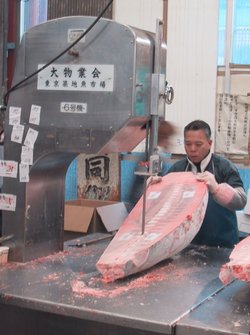
Frozen tuna being slides – courtesy of Wikipedia.
There are many interesting facts about tuna (courtesy of wikipedia). It is one of the few fish that is warm blooded. Most fish are cold blooded and as assume the temperature of the water surrounding. This gives them very little range in terms of their ability to travel. Tuna has a higher oxygen carrying ability than any other fish species. As a result, the flesh of tuna is pink (unlike most white flesh ocean fish). Bluefin can use muscle activity to actually increase their body temperature above the surrounding waters.
We had what is rumoured to be the best sushi in Tokyo; breakfast at the market. For 600 Yen I had fantastic tuna steak with tea. At this point we were all beginning to feel a little worse for wear by the end and decided to leave at about 8am.
The parting shot – leaving the market with shopping and heads in our hands. This is the only photo we managed to take (at least that I'm allowed show) ...
Tuesday, April 12, 2005
yakult - the elixir of life?
curious “fever prevention” broth
No visit to Japan would be complete without a blog about yakult. The little drink is as much an icon of the society as noodles, fish and slurping...
Yakult was developed by Dr Minoru Shirota in Kyoto, Japan in the 1930s. It is what is called a probiotic; containing "friendly bacteria" thought to counter the "dangerous bacteria" that can cause disease. There is much debate as to whether the bacteria in probiotic drinks actually survive the digestive system in order to provide any substantial benefit. This is not a time for scientific debate; this is a time to celebrate a cultural oddity...
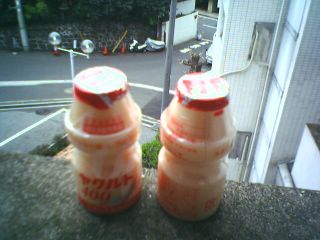
bottles of yakult admire the view whilst on a date
some facts about Yakult:
- the company is called yakult honsha
- Lactobacillus casei strain Shirota is the highly concentrated bacteria found in the drink
- In Japan, yakult costs 370 yen for a 5 pack - approximately £4.92 per litre. In the UK it costs £5.91 per litre.
- they sell approximately 15m of the little bottles 23 countries annually
- Danone owns 19% of the company
- a hong kong paper published an article stating the yakult could help prevent SARS. panic buying ensued (yakult started selling approx. 1m bottles a day in HK and east asia) until the company was forced to announce that, whilst it will "keep you healthy and less prone to getting the virus", there was no studies to support the fact that yakult could actually prevent or cure SARS. note: whiskey and cigarettes were also rumoured to have beneficial effects on SARS
- in 1998 the chairman and vice-president resigned over losses of $800m due to speculative trading
- the company owns an appropriately named baseball team "yakult swallows"
- the brand is hailed by academics as a leading example of education marketing - building awareness through first-hand contact with consumers; sampling, seminars and trademarked packaging
- there is a direct to consumer distribution channel in japan (much like newspapers and milk in the west). this is called the "unique yakult ladies system of door-to-door distribution"

the "unique yakult ladies" work on a commission basis ~ they can earn upto £50k pa; good reason to smile
- yakult has been found to relieve ulcerative colitis, decrease risk of bowel and colon cancers, cut cholsterol levels. A Swedish study connected it to reduced risk of asthma and allergies in babies... they may also help elderly people as the levels of good bacteria decline with age...
- many western scientists call yakult a "novel food"; being unsupported by clinical trials. whatever about the longterm benefits, there is general agreement that yakult induces bowel movement... hmm.
recipe for "fever prevention":
to try and keep somewhat the food blog theme; yakult recommend a natural prevention for colds and fevers:
- 1 drop lemon juice
- 1 drop eucalyptus oil
- 1 drop tea tree oil
- yakult
- hot water
mix in a bowl. place a towel over your head and inhale the vapours... good luck.
No visit to Japan would be complete without a blog about yakult. The little drink is as much an icon of the society as noodles, fish and slurping...
Yakult was developed by Dr Minoru Shirota in Kyoto, Japan in the 1930s. It is what is called a probiotic; containing "friendly bacteria" thought to counter the "dangerous bacteria" that can cause disease. There is much debate as to whether the bacteria in probiotic drinks actually survive the digestive system in order to provide any substantial benefit. This is not a time for scientific debate; this is a time to celebrate a cultural oddity...
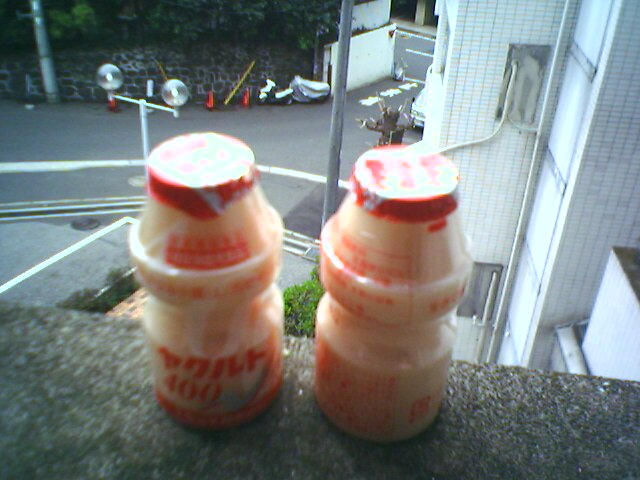
bottles of yakult admire the view whilst on a date
some facts about Yakult:
- the company is called yakult honsha
- Lactobacillus casei strain Shirota is the highly concentrated bacteria found in the drink
- In Japan, yakult costs 370 yen for a 5 pack - approximately £4.92 per litre. In the UK it costs £5.91 per litre.
- they sell approximately 15m of the little bottles 23 countries annually
- Danone owns 19% of the company
- a hong kong paper published an article stating the yakult could help prevent SARS. panic buying ensued (yakult started selling approx. 1m bottles a day in HK and east asia) until the company was forced to announce that, whilst it will "keep you healthy and less prone to getting the virus", there was no studies to support the fact that yakult could actually prevent or cure SARS. note: whiskey and cigarettes were also rumoured to have beneficial effects on SARS
- in 1998 the chairman and vice-president resigned over losses of $800m due to speculative trading
- the company owns an appropriately named baseball team "yakult swallows"
- the brand is hailed by academics as a leading example of education marketing - building awareness through first-hand contact with consumers; sampling, seminars and trademarked packaging
- there is a direct to consumer distribution channel in japan (much like newspapers and milk in the west). this is called the "unique yakult ladies system of door-to-door distribution"
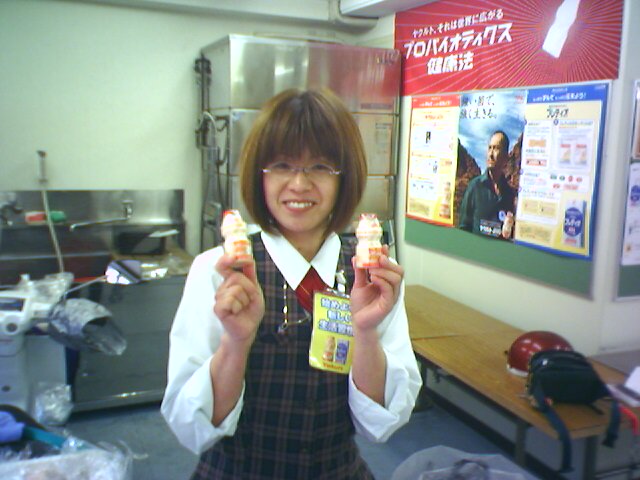
the "unique yakult ladies" work on a commission basis ~ they can earn upto £50k pa; good reason to smile
- yakult has been found to relieve ulcerative colitis, decrease risk of bowel and colon cancers, cut cholsterol levels. A Swedish study connected it to reduced risk of asthma and allergies in babies... they may also help elderly people as the levels of good bacteria decline with age...
- many western scientists call yakult a "novel food"; being unsupported by clinical trials. whatever about the longterm benefits, there is general agreement that yakult induces bowel movement... hmm.
recipe for "fever prevention":
to try and keep somewhat the food blog theme; yakult recommend a natural prevention for colds and fevers:
- 1 drop lemon juice
- 1 drop eucalyptus oil
- 1 drop tea tree oil
- yakult
- hot water
mix in a bowl. place a towel over your head and inhale the vapours... good luck.
visiting kyoto with mr. steingarten - day one
In his book "the man who ate everything" jeffrey steingarten brilliantly recounts his visit to and awe of kyoto cuisine. I read this on my last flight from tokyo and vowed to myself that i would go to Kyoto and retrace his steps; a culinary pilgrimage. My preparation for the trip involved photocopying the chapter. We neglected to read any guidebooks, this was going to be a spiritual journey to the spiritual heart of Japan.
Taro and myself started out on friday at midnight with a night coach from shinjuku, tokyo. Mr. steingarten arrived at kyoto on a luxury cruise ship after travelling around the southern half of japan. I should point out that this was going to be a budget remake of his trip. The night bus was quite a curious thing; similar to lying in a coffin on top of a speeding flying carpet. "Fitful" best describes the night's sleep; "relieved" best describes my mood on arrival.
Kyoto was japan's capital city for just under 1100 years. It is still the emotional capital of the country and home to many temples. We arrived at 7am. Knowing that it would be height of glutony for us to start eating immediately, we got the bus to the golden pavilion (Kinkajuji). This is a UNESCO world heritage site with a garden that remains as it did hundreds of years ago. I don't want to appear unimpressed by the temples of Kyoto, they are truly magnificent. My personal view is that I would rather get away from the crowds of tourists, the flash of the camera and experience the real life of the city ~ I'll leave it at that.

the pond is called kyoko-chi (mirror pond) ... i wonder why
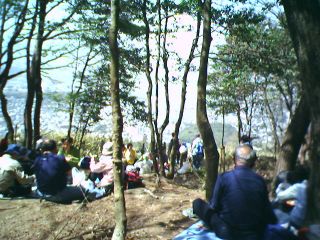
Now that we had done the "intellectual" part of the trip, we decided to get onto the subject of our visit... la comida... An unexpected hanami party on the philosopher's walk led us to the ginkakuji temple. Somewhat controversially we performed a deft left turn and (in order to see the view and build our appetite) climbed the Higashiyama Mountain. We arrived to the top sweating and gasping with heart palpitations. It was quite a humbling experience to find about 100 pensioners who apparently had made the trip earlier, faster and with picnics (no wonder Japan has the longest life expectancy of any country in the world). There was only one thing for this ... revenge through eating...
We went to Kawaramachi, the main food and shopping district for okonomiyaki. This is in fact an Osakan specialty, but as we were only half an hour away we didn't feel much remorse. Okonomiyaki is a thick savoury pancake that contains shredded cabbage and diced seafood or meat. It is most often topped with tonkatsu sauce, mayonnaise / mustard, tempura crumbs, green onions and bonito flakes. It is cooked much like Teppenyaki, on a grill in front of the diner. The food is then moved to the cooler, diner side, of the grill to be eaten. It is not exactly healthy, but is really delicious after a climb. It calms bruised egos.

As you can probably tell, the whole weekend hadn't exactly been planned up to this point. Having had our first meal, we were at a cross roads, a moment that would most likely shape the remainder of the weekend and perhaps my memories of this part of Japan. We had two options - get a hotel in Kyoto or go to Osaka to meet Jumpei, an old friend of Taro's. Given that we had no hotel booking and that all seemed to be full, we decided that we really did want to head to Osaka.
Osaka is Japan's second most important city and the third largest. If that doesn't give you enough of summary, you can find the city's fy2005 budget proposal here. After only one night there I can say that its population of 2.5m are nearly all mad! This was a ... varied night; I'm going to give you the edited highlights.
JS mentions the ongoing debate as to whether Osaka or Kyoto have the best cuisine in Japan. I'd have to go with Osaka in this debate (mostly because the great cuisine of Kyoto; kaiseki ryori was somewhat too expensive for this weekend). Jumpei explained to us over dinner that the Osakan philosophy of food is ruled by a continuous quest for improvement. They are passionate about food. The local word "Kuidaore" probably best describes this; "to eat oneself bankrupt".
The other thing that you may do in Osaka is "eat yourself dead". As we all know, the best way to do this is with blowfish. For this reason (and to my eternal surprise) we went to a blowfish restaurant. Before you think this was crazy, my arm was twisted by Taro and Jumpei saying that more blowfish is eaten in Osaka than anywhere else in Japan. They insisted that the death "rumour" is vastly overblown (hah) and, more importantly, the fish is extremely good. The liver is the dangerous part of the fish; chefs will train for years to prepare the food. I was going to post instructions on how to cut it, but i don't want to be sued. I will mention that the kanji for blowfish is 河豚 (river-pig; obviously because a: it's not a pig and b: it comes from the sea) ...

would you trust either of these two? i can't believe i did ...
My first bite was the most difficult, but thereafter this was an incredible meal. The meat is actually quite delicate and when cooked reveals a surprisingly chickeny flavour. You are supposed to get a tingling sensation, especially on the lips, but I have to be honest and say that I didn't. The beer did give me a drunken sensation.
We ate a very traditional meal including:
Fugu skin - blanched in boiling water and eaten with ponzu sauce (soy sauce and citrus juice)
Fugu-sashi - thinly sliced raw fugu, basically sashimi
Fugu-chiri - similar to a chanko-nabe; vegetables and fugu cooked in dashi soup in a large pot
Fugu Kara-age - floured and deep fried
Fugu testicles - unsurprisingly soft and, my dignity would say, not the tastiest part of the meal
Investigations on the web have since revealed:
- there are 100 deaths a year caused by blowfish; this has been contradicted by another source quoting only one death
- blowfish is the only delicacy that is not permitted to be served to the emperor
- tip from lonely planet "make sure the local emergency number is plugged into your mobile. Given that mine doesn't work in Japan I didn't feel so aggrieved about not obeying this recommendation
- it is the only species of fish that can close its eyes
Given that I had lived through the experience, we went out to celebrate for the evening. This culminated with checking into a capsule hotel at 5am ... Mr. S never told me about this.
Next on zarzamora - getting out of Osaka alive, getting sidetracked by more food and a visit to THE food market.
Taro and myself started out on friday at midnight with a night coach from shinjuku, tokyo. Mr. steingarten arrived at kyoto on a luxury cruise ship after travelling around the southern half of japan. I should point out that this was going to be a budget remake of his trip. The night bus was quite a curious thing; similar to lying in a coffin on top of a speeding flying carpet. "Fitful" best describes the night's sleep; "relieved" best describes my mood on arrival.
Kyoto was japan's capital city for just under 1100 years. It is still the emotional capital of the country and home to many temples. We arrived at 7am. Knowing that it would be height of glutony for us to start eating immediately, we got the bus to the golden pavilion (Kinkajuji). This is a UNESCO world heritage site with a garden that remains as it did hundreds of years ago. I don't want to appear unimpressed by the temples of Kyoto, they are truly magnificent. My personal view is that I would rather get away from the crowds of tourists, the flash of the camera and experience the real life of the city ~ I'll leave it at that.
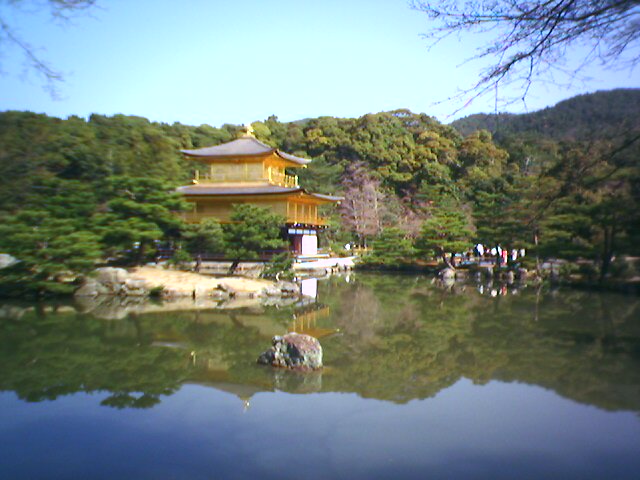
the pond is called kyoko-chi (mirror pond) ... i wonder why
Now that we had done the "intellectual" part of the trip, we decided to get onto the subject of our visit... la comida... An unexpected hanami party on the philosopher's walk led us to the ginkakuji temple. Somewhat controversially we performed a deft left turn and (in order to see the view and build our appetite) climbed the Higashiyama Mountain. We arrived to the top sweating and gasping with heart palpitations. It was quite a humbling experience to find about 100 pensioners who apparently had made the trip earlier, faster and with picnics (no wonder Japan has the longest life expectancy of any country in the world). There was only one thing for this ... revenge through eating...

We went to Kawaramachi, the main food and shopping district for okonomiyaki. This is in fact an Osakan specialty, but as we were only half an hour away we didn't feel much remorse. Okonomiyaki is a thick savoury pancake that contains shredded cabbage and diced seafood or meat. It is most often topped with tonkatsu sauce, mayonnaise / mustard, tempura crumbs, green onions and bonito flakes. It is cooked much like Teppenyaki, on a grill in front of the diner. The food is then moved to the cooler, diner side, of the grill to be eaten. It is not exactly healthy, but is really delicious after a climb. It calms bruised egos.

As you can probably tell, the whole weekend hadn't exactly been planned up to this point. Having had our first meal, we were at a cross roads, a moment that would most likely shape the remainder of the weekend and perhaps my memories of this part of Japan. We had two options - get a hotel in Kyoto or go to Osaka to meet Jumpei, an old friend of Taro's. Given that we had no hotel booking and that all seemed to be full, we decided that we really did want to head to Osaka.
Osaka is Japan's second most important city and the third largest. If that doesn't give you enough of summary, you can find the city's fy2005 budget proposal here. After only one night there I can say that its population of 2.5m are nearly all mad! This was a ... varied night; I'm going to give you the edited highlights.
JS mentions the ongoing debate as to whether Osaka or Kyoto have the best cuisine in Japan. I'd have to go with Osaka in this debate (mostly because the great cuisine of Kyoto; kaiseki ryori was somewhat too expensive for this weekend). Jumpei explained to us over dinner that the Osakan philosophy of food is ruled by a continuous quest for improvement. They are passionate about food. The local word "Kuidaore" probably best describes this; "to eat oneself bankrupt".
The other thing that you may do in Osaka is "eat yourself dead". As we all know, the best way to do this is with blowfish. For this reason (and to my eternal surprise) we went to a blowfish restaurant. Before you think this was crazy, my arm was twisted by Taro and Jumpei saying that more blowfish is eaten in Osaka than anywhere else in Japan. They insisted that the death "rumour" is vastly overblown (hah) and, more importantly, the fish is extremely good. The liver is the dangerous part of the fish; chefs will train for years to prepare the food. I was going to post instructions on how to cut it, but i don't want to be sued. I will mention that the kanji for blowfish is 河豚 (river-pig; obviously because a: it's not a pig and b: it comes from the sea) ...
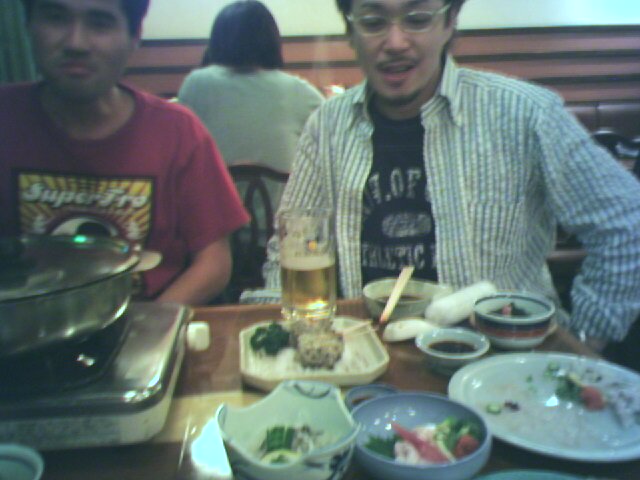
would you trust either of these two? i can't believe i did ...
My first bite was the most difficult, but thereafter this was an incredible meal. The meat is actually quite delicate and when cooked reveals a surprisingly chickeny flavour. You are supposed to get a tingling sensation, especially on the lips, but I have to be honest and say that I didn't. The beer did give me a drunken sensation.
We ate a very traditional meal including:
Fugu skin - blanched in boiling water and eaten with ponzu sauce (soy sauce and citrus juice)
Fugu-sashi - thinly sliced raw fugu, basically sashimi
Fugu-chiri - similar to a chanko-nabe; vegetables and fugu cooked in dashi soup in a large pot
Fugu Kara-age - floured and deep fried
Fugu testicles - unsurprisingly soft and, my dignity would say, not the tastiest part of the meal
Investigations on the web have since revealed:
- there are 100 deaths a year caused by blowfish; this has been contradicted by another source quoting only one death
- blowfish is the only delicacy that is not permitted to be served to the emperor
- tip from lonely planet "make sure the local emergency number is plugged into your mobile. Given that mine doesn't work in Japan I didn't feel so aggrieved about not obeying this recommendation
- it is the only species of fish that can close its eyes
Given that I had lived through the experience, we went out to celebrate for the evening. This culminated with checking into a capsule hotel at 5am ... Mr. S never told me about this.
Next on zarzamora - getting out of Osaka alive, getting sidetracked by more food and a visit to THE food market.
Thursday, April 07, 2005
hunting for hanami
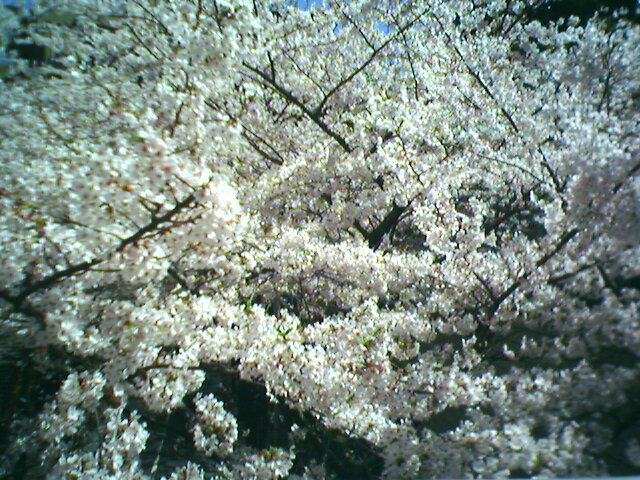
before i last left tokyo i was told that i would be returning during the hanami (literally flower viewing) festival. i did some investigation before coming back so that i would be up to speed. it is true, this week is the best for cherry blossom in tokyo. i'm fortunate, this is a pretty spectacular cultural phenomenon. it not only marks the beginning of spring, but also the beginning of the academic and fiscal year (it strikes fear into the hearts of young and old equally) ...

there is a website dedicated to "how to do hanami", here is a brief excerpt ...
"Cherry blossom viewing is easy: Simply enjoy the intensity of the many blossoms by looking at a single tree or a group of trees. From a distance, the trees appear as beautiful clouds, while the beauty of single blossoms can be enjoyed from a close distance."
this site goes onto say that blossom is especially beautiful when viewed with a castle, temple or shrine. in addition to philosophical help, the fledging viewer can also get meteorological aid; there are forecasts published to help people plan when and where to see the best blossom.
given this wealth of information we went out well prepared this lunchtime to experience the blossom. tokyo, it seems, is a big city, with a lot of concrete and many trees. unfortunately, like most things, it's only when you start looking for a cherry tree that you can't find it.
eventually we found a cherry blossom behind a large wall, but couldn't get to it.

in order to build some energy for climbing the wall we decided to make a quick stop for lunch. it is possible during the festival to reserve spaces in the big parks and have a picnic. we were a little less prepared, after rejecting subway, we went for another traditional dish; chinese takeaway. we had rice porridge, tantanmen and marbled tofu.
a typical food during hanami is dango, a sweet rice dumpling on skewer. there is an expression in japan; "hana yori dango" meaning "i would rather eat dango than view cherry blossoms" ... seems unduly harsh.
disappointed that i hadn't seen hanami we started back to the office. upon turning a corner we stumbled across a mini-hanami party. i believe that this group of people had read the recommendations from above and taken almost all of them on board, although, they have sensibly substituted the back of the ana hotel in roppongi for a temple or shrine.

if you want to experience your own virtual hanami you can download the screensaver. enjoy the intensity of many blossoms by looking at your pc monitor ... yeaaaah ...
there is a website dedicated to "how to do hanami", here is a brief excerpt ...
"Cherry blossom viewing is easy: Simply enjoy the intensity of the many blossoms by looking at a single tree or a group of trees. From a distance, the trees appear as beautiful clouds, while the beauty of single blossoms can be enjoyed from a close distance."
this site goes onto say that blossom is especially beautiful when viewed with a castle, temple or shrine. in addition to philosophical help, the fledging viewer can also get meteorological aid; there are forecasts published to help people plan when and where to see the best blossom.
given this wealth of information we went out well prepared this lunchtime to experience the blossom. tokyo, it seems, is a big city, with a lot of concrete and many trees. unfortunately, like most things, it's only when you start looking for a cherry tree that you can't find it.
eventually we found a cherry blossom behind a large wall, but couldn't get to it.

in order to build some energy for climbing the wall we decided to make a quick stop for lunch. it is possible during the festival to reserve spaces in the big parks and have a picnic. we were a little less prepared, after rejecting subway, we went for another traditional dish; chinese takeaway. we had rice porridge, tantanmen and marbled tofu.
a typical food during hanami is dango, a sweet rice dumpling on skewer. there is an expression in japan; "hana yori dango" meaning "i would rather eat dango than view cherry blossoms" ... seems unduly harsh.
disappointed that i hadn't seen hanami we started back to the office. upon turning a corner we stumbled across a mini-hanami party. i believe that this group of people had read the recommendations from above and taken almost all of them on board, although, they have sensibly substituted the back of the ana hotel in roppongi for a temple or shrine.

if you want to experience your own virtual hanami you can download the screensaver. enjoy the intensity of many blossoms by looking at your pc monitor ... yeaaaah ...
Thursday, March 24, 2005
tonkatsu - why do pork and cabbage date?
tonkatsu
i'm getting one of the 'monkeys off my back' and eventually getting to blog about tonkatsu. interestingly, according to the dictionary of american slang, 'monkey off my back' relates to an addiction; physical or mental ~ i believe i may qualify for both ... the dependency on the food and the philosophical question that has intrigued me for the past number of weeks (more of which below) ...
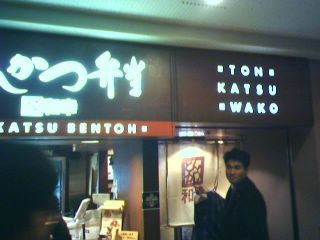
the name tonkatsu is formed of 'ton' meaning pig/pork and 'katsu' meaning cutlet. the meal is young in relation to other japanese food, it dates to the 1930's. it is typical 'modern' japanese cuisine. some feel that its history goes to the european 'schitzel'; the difference being that it is deep fried rather than shallow fried.
when we first started working in tokyo in october last year, greg and myself instantly fell in love with it. after a couple of weeks we were up to about 3 servings a week until we decided we should slow down for health reasons. in honour of the michael jackson trial this week, we went to our favourite tonkatsu restaurant chain; tonkatsu wako (photo above). with 236 outlets nationwide, the 47 year old chain produces, in our opinion, the most consistently tasty tonkatsu meal in japan.
ingredients: 4 slices of pork loin or fillet, 1 beaten egg, 1 cup bread crumbs (panko), 1/4 cup flour, oil, salt and pepper
season the pork and coat it in flour. dip the meat in egg and cover in breadcrumbs. refrigerate for 30 minutes. fry until golden brown. there are two regular variations of the traditional tonkatsu: katsudon is tonkatsu served on a bed of rice, katsu-curry is served with rice and curry sauce.
the garnishing and pairings for the main dish are the most important part of the menu:
- tonkatsu sauce is a variation on brown sauce. it can be faked by mixing worchester sauce with some ketchup.
- grated cabbage. cabbage is nearly always served with tonkatsu. it is usually soaked in water for half an hour in order to preserve its flavour and crisp it. large faced graters are used to grate across the heart of the cabbage. an interesting marketing ploy in japan offers 'bottomless' cabbage in tonkatsu restaurants. i can't be certain, but i don't think it would be as popular in the west as coke, albeit more healthy.
- karashi (japanese mustard). very similar to english mustard.
- miso soup. as with many lunch menus, miso soup is generally served. wako does a great line on miso soup with clams.
- rice. as with everything in japan, there is logic and a good deal of thought that has gone into apparently simple or random occurrences ... generally, the tonkatsu is presented to the diner on a tray complete with main meal, rice and miso. the two smaller bowls (rice and miso) are generally in the left and right corners nearest to the diner. when i would receive the tray i would always rotate the tray in 180degrees in order to put the bowls on the opposite side and help accessibility to the main meal. this is a mistake. taro pointed out that the rice is served on the left side of the customer in order to allow them eat the main meal (chopsticks generally in right hand) and hold the rice bowl in left hand ~ more ergonomic, faster and aids the mixing of flavours; rice and tonkatsu.

rice on the left ... soup on the right ... steve is allowed stay in the restaurant
good blog about tonkatsu: http://maki.typepad.com/justhungry/2004/01/tonkatsu.html
one thing i've wondered is why do these pairings fit together so well? if i hadn't asked myself this question, i would have perhaps been able to make this post weeks earlier ...
- the combination of cabbage and pork is one that is also made in the west where red cabbage is often used. i have searched books and internet like a man possessed, but there is very little concrete explanation as to why this connection is made other than it adds an interesting flavour dimension to the pork. my feeling is that the cabbage freshens the palate after a mouthfull of deep fry; it is a contrast in terms of texture and temperature to the warm and tender pork.
- brown sauce is typically served with meats, it is popular in japan and can be found in many restaurants. the sweet and strong flavour is considered to go well with any fried foods.
- mustard is a member of the cabbage family and has the same relationship with pork as cabbage itself. it balances the richness of the pork.
- the rice serves to form a base to mix the pork and sauce in the mouth ... the cabbage serves to cut through the starch of the rice and cleanse the palate?
one interesting idea that i stumbled across could be that the various ingredients aim to drive a neutral ph level in the meal... cabbage is moderately alkaline forming (ph 7.5), miso and mustard are slightly acid to neutral (ph 7.0) whereas rice and pork are extremely acid forming (ph 5.5). ph levels taken from http://www.greatestherbsonearth.com/articles/acid_alkaline.htm
if anyone has any ideas why the above combinations are made please post them as comments or mail them to me ... it would help me sleep better over the next few weeks ...
i'm getting one of the 'monkeys off my back' and eventually getting to blog about tonkatsu. interestingly, according to the dictionary of american slang, 'monkey off my back' relates to an addiction; physical or mental ~ i believe i may qualify for both ... the dependency on the food and the philosophical question that has intrigued me for the past number of weeks (more of which below) ...
the name tonkatsu is formed of 'ton' meaning pig/pork and 'katsu' meaning cutlet. the meal is young in relation to other japanese food, it dates to the 1930's. it is typical 'modern' japanese cuisine. some feel that its history goes to the european 'schitzel'; the difference being that it is deep fried rather than shallow fried.
when we first started working in tokyo in october last year, greg and myself instantly fell in love with it. after a couple of weeks we were up to about 3 servings a week until we decided we should slow down for health reasons. in honour of the michael jackson trial this week, we went to our favourite tonkatsu restaurant chain; tonkatsu wako (photo above). with 236 outlets nationwide, the 47 year old chain produces, in our opinion, the most consistently tasty tonkatsu meal in japan.
ingredients: 4 slices of pork loin or fillet, 1 beaten egg, 1 cup bread crumbs (panko), 1/4 cup flour, oil, salt and pepper
season the pork and coat it in flour. dip the meat in egg and cover in breadcrumbs. refrigerate for 30 minutes. fry until golden brown. there are two regular variations of the traditional tonkatsu: katsudon is tonkatsu served on a bed of rice, katsu-curry is served with rice and curry sauce.
the garnishing and pairings for the main dish are the most important part of the menu:
- tonkatsu sauce is a variation on brown sauce. it can be faked by mixing worchester sauce with some ketchup.
- grated cabbage. cabbage is nearly always served with tonkatsu. it is usually soaked in water for half an hour in order to preserve its flavour and crisp it. large faced graters are used to grate across the heart of the cabbage. an interesting marketing ploy in japan offers 'bottomless' cabbage in tonkatsu restaurants. i can't be certain, but i don't think it would be as popular in the west as coke, albeit more healthy.
- karashi (japanese mustard). very similar to english mustard.
- miso soup. as with many lunch menus, miso soup is generally served. wako does a great line on miso soup with clams.
- rice. as with everything in japan, there is logic and a good deal of thought that has gone into apparently simple or random occurrences ... generally, the tonkatsu is presented to the diner on a tray complete with main meal, rice and miso. the two smaller bowls (rice and miso) are generally in the left and right corners nearest to the diner. when i would receive the tray i would always rotate the tray in 180degrees in order to put the bowls on the opposite side and help accessibility to the main meal. this is a mistake. taro pointed out that the rice is served on the left side of the customer in order to allow them eat the main meal (chopsticks generally in right hand) and hold the rice bowl in left hand ~ more ergonomic, faster and aids the mixing of flavours; rice and tonkatsu.

rice on the left ... soup on the right ... steve is allowed stay in the restaurant
good blog about tonkatsu: http://maki.typepad.com/justhungry/2004/01/tonkatsu.html
one thing i've wondered is why do these pairings fit together so well? if i hadn't asked myself this question, i would have perhaps been able to make this post weeks earlier ...
- the combination of cabbage and pork is one that is also made in the west where red cabbage is often used. i have searched books and internet like a man possessed, but there is very little concrete explanation as to why this connection is made other than it adds an interesting flavour dimension to the pork. my feeling is that the cabbage freshens the palate after a mouthfull of deep fry; it is a contrast in terms of texture and temperature to the warm and tender pork.
- brown sauce is typically served with meats, it is popular in japan and can be found in many restaurants. the sweet and strong flavour is considered to go well with any fried foods.
- mustard is a member of the cabbage family and has the same relationship with pork as cabbage itself. it balances the richness of the pork.
- the rice serves to form a base to mix the pork and sauce in the mouth ... the cabbage serves to cut through the starch of the rice and cleanse the palate?
one interesting idea that i stumbled across could be that the various ingredients aim to drive a neutral ph level in the meal... cabbage is moderately alkaline forming (ph 7.5), miso and mustard are slightly acid to neutral (ph 7.0) whereas rice and pork are extremely acid forming (ph 5.5). ph levels taken from http://www.greatestherbsonearth.com/articles/acid_alkaline.htm
if anyone has any ideas why the above combinations are made please post them as comments or mail them to me ... it would help me sleep better over the next few weeks ...
Friday, February 18, 2005
karei raisu
if i flatter myself to thinking that if previous mails have been looking at some of the 'intellectual' aspects of japanese cuisine, this is looking at the one of the oddities of japanese cuisine ... curry rice or as the japanese call it; karei raisu (um, basically the same).
this was brought to japan in the meiji era; 1869 to 1913, but, as with most things in japan, has become most successful after world war 2 when private foreign trade was opened. it is a favourite at lunchtime i guess mainly because it covers the bases of rice, port or vegetables and the ability to eat out of a lunchbox.
today we went to a nationwide chain called cocoichibanya - this chain has over 1,000 stores nationwide; this is not just simple curry and rice - this is an empire.
the thing that got me was the scope of the menu; there are about 50 different types of curry ingredient on offer, basically if you can kill it or grow it you will find it at the cocoichi restaurants ... including the deep fried burger in curry ...
as with all lunch / fast restaurants, the focus here is on the speed of turnaround of customer. for this reason coco have developed a simple and, well in fact, deceptively complex "steps to place and order" ... i will try and describe the main steps:
1. the diner is required to choose the type of curry, here we have a choice of pork, beef, sweet pork or pork stew ... i have only eaten pork, but will try the others soon.
2. next we need to establish what size of rice is required. now, apparently there is competition, if you can eat 1.2kg of rice and equivalent sauce you can get your lunch free (and presumably the ambulance to the hospital)
3. the heat of your curry - going from 1 to 10. for a country that doesn't have a reputation for hot foods, it does surprise me that level 2 was more than hot for me - Taro settled for level 1. i did find myself wondering what 1.2kg gussling wonders managed to eat level 10 curries
4. finally the customer chooses the base ingredients with varying kcal depending on the combinations of choice - it is here where we gave up translating
presumably after this exhaustive ordering process all of the customers are hungry enough to eat the food when it arrives. i ordered the "grand mother" dish (maybe called so becuase even grandmothers can eat it) and was disappointed when i didn't win one of the prize curry spoons. this may not seem like such a great prize to us westerners, but when you've been eating with sticks all your life, it's a bit of a revelation.
nevertheless, the curry is fantastic - to locate your nearest store (no doubt it is coming to europe soon), you can check website: http://www.ichibanya.co.jp
for more info on curry in japan: http://japanesefood.about.com/library/weekly/aa052701a.htm
this was brought to japan in the meiji era; 1869 to 1913, but, as with most things in japan, has become most successful after world war 2 when private foreign trade was opened. it is a favourite at lunchtime i guess mainly because it covers the bases of rice, port or vegetables and the ability to eat out of a lunchbox.
today we went to a nationwide chain called cocoichibanya - this chain has over 1,000 stores nationwide; this is not just simple curry and rice - this is an empire.
the thing that got me was the scope of the menu; there are about 50 different types of curry ingredient on offer, basically if you can kill it or grow it you will find it at the cocoichi restaurants ... including the deep fried burger in curry ...
as with all lunch / fast restaurants, the focus here is on the speed of turnaround of customer. for this reason coco have developed a simple and, well in fact, deceptively complex "steps to place and order" ... i will try and describe the main steps:
1. the diner is required to choose the type of curry, here we have a choice of pork, beef, sweet pork or pork stew ... i have only eaten pork, but will try the others soon.
2. next we need to establish what size of rice is required. now, apparently there is competition, if you can eat 1.2kg of rice and equivalent sauce you can get your lunch free (and presumably the ambulance to the hospital)
3. the heat of your curry - going from 1 to 10. for a country that doesn't have a reputation for hot foods, it does surprise me that level 2 was more than hot for me - Taro settled for level 1. i did find myself wondering what 1.2kg gussling wonders managed to eat level 10 curries
4. finally the customer chooses the base ingredients with varying kcal depending on the combinations of choice - it is here where we gave up translating
presumably after this exhaustive ordering process all of the customers are hungry enough to eat the food when it arrives. i ordered the "grand mother" dish (maybe called so becuase even grandmothers can eat it) and was disappointed when i didn't win one of the prize curry spoons. this may not seem like such a great prize to us westerners, but when you've been eating with sticks all your life, it's a bit of a revelation.
nevertheless, the curry is fantastic - to locate your nearest store (no doubt it is coming to europe soon), you can check website: http://www.ichibanya.co.jp
for more info on curry in japan: http://japanesefood.about.com/library/weekly/aa052701a.htm
Thursday, February 17, 2005
maratakaya
i first realised that ramen was something special about ramen when taro outlined his philosophy to blancs and myself. this was a serious and detailed discussion where he often used his brothers and father as comparison. that was last october, since then i have tried quite a bit and learnt a little about this seemingly simple food.
after another viewing of tampopo, 2 focused trips to japan and perhaps25 meals, this weekend i was finally ready to be brought to toyama fora ramen lunch with taro's father. when it comes to food there is no half measures with the people of toyama - when it comes to ramen thisis a religious experience so i had to be prepared.
after another viewing of tampopo, 2 focused trips to japan and perhaps25 meals, this weekend i was finally ready to be brought to toyama fora ramen lunch with taro's father. when it comes to food there is no half measures with the people of toyama - when it comes to ramen thisis a religious experience so i had to be prepared.
tampopo: http://www.imdb.com/title/tt0092048/
the ramen store that they chose to bring me is located in the centre of toyama city. this family store is now run by the grandson (a youngcook with appropriately intimidating beard and uniform). originallystarting as an oden (boiled vegetables) stall outside the town trainstation, his grandfather soon discovered particular enthusiasm fromhis customers for his ramen soup and noodles. he since set up thisstore with his son and they have specialised in ramen.
upon entering i was confident that i would have tasted better. aswith all restaurants, you immediately get welcomes by the "suimasen"from staff. the kitchen itself was surrounded in an "L" by the ramenbar, but much to my surprise there was also a long bar on the oppositeside of the little store (as mentioned below, my developing philosophydoesn't agree with this, following my tampopo teachings, all the cooksshould be able to see the faces and bowls of their customers. taro'sfamily agree that this extended bar is perhaps a little bit of asacrifice to the massive demand at this store).
it was surprisingly busy for 2pm on a sunday - this boded well. forappetizer we ordered a specialty of the store, kushi; pork oden on askewer with a sweet sauce and a side of english mustard. we also had
wari "divided/mixed"); this is made of shochu and red wine.
more about shochu: http://www.sake-world.com/html/shochu-awamori.html
the ramen arrived. unlike the tokyo stores that i have been to, thisshop specialises in only one type of ramen soup - pork soup. thebowls arrived piping hot. i still haven\'t developed a trueunderstanding of the compliments to ramen so i followed the family inadding a small spoonful of grated garlic and crushed tempura.
the first spoonful of soup was when it hit me ... for the first time,i noticed the stock of the soup. it was a light broth with almost acentimetre of clear fat on top - incredibly tasty. the ramen itselfwas yellow and very curled in comparison with the straighter noodlesin tokyo. the entire bowl was something to savour - only when youhave tased the flavour of good soup (the heart as taro\'s dad calls it)can you really compare other ramen ...
i knocked my water back at one point and something that had neverhappened occurred; the cook noticed that i had finished and called oneof the waitresses over to refill my glass. this is the tampopoeffect; he was aware what all of his customers were eating and wasreading their reactions at all times.
given that i somewhat stand out in toyama, we were brave enough totalk to the cook. taro explained that i had eaten ramen all overtokyo, but this was by far the best. he thanked me and we deliveredthe question - what was the stock made of. normally you would neverask this question, but given that i was a tourist the cook obliged myignorance and answered that it was pork with a little bit of fishstock - this is as close as i will ever get to knowing the truth ...
my philosophy (insofar as i can have one) ...
1. pork soup is the only one worthwhile (others are soya, salt andmiso) - you should be able to see fat on top of the your firstspoonful
2. the store should specialise in one ramen soup rather than try andcover all the soups
3. the bar should go round the borders of the kitchen, with customersfacing the cook
4. ramen should be yellow, strong and curled
5. always finish your bowl unless you want to send a strong message to the cook
6. sweat - you need to go through some pain in order to deserve goodramen. i\'ve been told that it is a good sign for restaurants to havetissues rather than the usual serviettes as this indicates peoplesweat ...

http://japanesefood.about.com/cs/noodles/a/ramen.htm
Post script (4th July 2005); Taro has just sent me a photo from Marutakaya (note the spelling change). It turns out that they have a website: http://www.marutakaya.co.jp/. This will help any of you get there if you are in need of some good noodles.
Wednesday, February 16, 2005
subway pushing
most people have heard the stories of people employed to pushpassengers onto the tokyo subway. the pushers (oshiya) have a prettyimportant job; trains arrive every 2 minutes and at rush hour are atsomething like 230% capacity as they bring the greater population (20+million) to work. at the same time, you can't help but think theyform part of japan's hidden unemployed (the job isn't required on anyother subway that i've been). assuming this was an exaggeration i hadnever been too bothered to experience it.
today it was raining so i got the train one stop to the office ...
arriving at the subway i had the usual moment of "these japanese arecrazy ..." there was a long line of people queueing perpendicularlyfrom the platform across the island. typical japanese; rather thanpeople trying to bustle closest to the doors, people are obedientenough to stand in a queue that leaves them with no chance to boardthe next train.
i missed the first train .... one door had jammed on a young guy andfrom nowhere 3 pushers (oshiya) appeared in order to "remove theblock" - the unfortunate bloke looked like he was having theequivalent to an invasive massage. the door was closed and with thesatisfaction with a job welldone, the oshiya retreated back to theisland pillars and the train depart on time.
the next train pulled up and i naively stepped onto the train ...within seconds i was hit by an inhuman force from behind; somethinglike strong wave. it forced me across the train and straight into theback of a guy on the other side. the strange thing was the exact samewas happening to everyone around me. this is a part of life here;people are very accepting of being forced into someone else's face andthey remain very calm about it.
i had my laptop bag with me which i was holding in my hand. thisforced me to make a social blunder ... we had been warned previously that if we were ever pushed into a train, to remember to keep our hands in the air, there are a number of perverts in japanese society thatare only too happy to be in close contact with girls on the train ...regrettably i travelled the couple of minutes to work with both handson the bottom of two young girls to my left and right ... i'm justglad they weren't men or grandmothers ...
when the doors opened in tameiko-sanno we poured from the train ...again i underestimated the force and speed and had to do everything inorder to keep my balance ...from now on i think i'll bring an umbrella and just walk ...
today it was raining so i got the train one stop to the office ...
arriving at the subway i had the usual moment of "these japanese arecrazy ..." there was a long line of people queueing perpendicularlyfrom the platform across the island. typical japanese; rather thanpeople trying to bustle closest to the doors, people are obedientenough to stand in a queue that leaves them with no chance to boardthe next train.
i missed the first train .... one door had jammed on a young guy andfrom nowhere 3 pushers (oshiya) appeared in order to "remove theblock" - the unfortunate bloke looked like he was having theequivalent to an invasive massage. the door was closed and with thesatisfaction with a job welldone, the oshiya retreated back to theisland pillars and the train depart on time.
the next train pulled up and i naively stepped onto the train ...within seconds i was hit by an inhuman force from behind; somethinglike strong wave. it forced me across the train and straight into theback of a guy on the other side. the strange thing was the exact samewas happening to everyone around me. this is a part of life here;people are very accepting of being forced into someone else's face andthey remain very calm about it.
i had my laptop bag with me which i was holding in my hand. thisforced me to make a social blunder ... we had been warned previously that if we were ever pushed into a train, to remember to keep our hands in the air, there are a number of perverts in japanese society thatare only too happy to be in close contact with girls on the train ...regrettably i travelled the couple of minutes to work with both handson the bottom of two young girls to my left and right ... i'm justglad they weren't men or grandmothers ...
when the doors opened in tameiko-sanno we poured from the train ...again i underestimated the force and speed and had to do everything inorder to keep my balance ...from now on i think i'll bring an umbrella and just walk ...
Monday, February 14, 2005
abundant mountains
we arrived into toyama train station at 10 on friday night - this had been my first time on a bullet train in japan. very impressive, i think we travelled about 600k across the country in the space of 4 hours - the bullet train only went half of the distance, but in about an hour. built in the 60's they are still impressive (travelling faster than the eurostar i think?); there is a feeling that they were a bit of propaganda at the time - playing on the ever proud nation and instilling the sense of japan leading the world in engineering and technology ...
the trains themselves (and this goes for all the trains) gave me the same sense of frugal comforts that you get all over japan - the chairs are straighbacked and not the most comfortable ... there is a sense the suffering and gain are very close in japanese society ...

toyama is the land of country bumpkins as taro had previously mentioned; tractors are used to clear metres of snow from the roads and people have to shovel their driveways everyday. it means abundant mountains and its two kanji represent this "abundant" 富 "mountain" 山... you can see that mountain is a good example of kanji deriving its shape from the object it represents; two smaller peaks flanking a tall mountain. another example that i spotted (believe it or not) this weekend is the kanji for fire ... 火 ... if you look at it, you can imagine wooden logs with three flames coming out on top ...
pretty good instructions from the usual companion ..:http://japanesefood.about.com/library/weekly/aa053100a.htm
the miyanishi house is very typical; everyone sleeps on futons and the walls are the typical sliding partitions that you see in the movies(photo 30). the house is incredibly cold (blancs you would sufferhere) - there is no plumbed heating, just gas stove burners in each room. i am sure that it was about zero in the room during the night.as long as my head was under the duvets and blankets it was fine ...
the next morning we made udonsuki ... a feature of the ever present japanese ethic not to waste anything. this consisted of taking theremains of the sukiyaki from the night before and reheating and extending with udon noodles for breakfeast. this was incredible -really rich flavours and just what you want at 6.30am when you aregoing out for a day of skiing. as far as i can recall, the first timei ever had udon noodles was in wagamamas in london - i hated them. iam now totally fascinated by them ...
http://www.worldramen.net/Varietion/udon/udons.html
the skiing itself was great - i used carving skis for my first timeand will never go back ... i also made my first real jump and landed on my ass, breaking the skis and thinking that i had broken my shoulder ... very cool ... all was fine.
taro's mum had made us a lunch of onigiri - this is basically the morning's rice pressed into balls the size of you fist ... we agreed that they suffered from a lack of salt, but this is more due to taro's mum's preference rather than any lack of skill. two onigiris each;one with salmon and the other with plumb. this was all we had to eat all day - other than that, we skied nearly 9 hours and never stopped... this is the way that skiing should be done!
i'm not ashamed to say that now, 2 days later my legs are stillaching. we went to a hot spring (onsen) after the skiing - this is the only reason that my legs will not be hurting tomorrow. after sometime outdoors in the hot water pool i was at least feeling more human. this onsen was a little different to the one we went to previously on the izu peninsula; becuase it's so close to the raicho valley ski resort, it was packed - loads of kids and fathers. there was even a place where everyone was washing themselves with soaps (most houses in these areas don't have bathrooms as we know them so bathing opportunities are taken where they are found) ... i'm not sure how successful naked bathing would be at home ...
the next day was the main gastronomic event of the weekend - the trip to toyama for ramen. after 4 weeks of study and tutelage ... how wasi going to stand up to the ultimate test against the philosophy of taro's father?
the trains themselves (and this goes for all the trains) gave me the same sense of frugal comforts that you get all over japan - the chairs are straighbacked and not the most comfortable ... there is a sense the suffering and gain are very close in japanese society ...

toyama is the land of country bumpkins as taro had previously mentioned; tractors are used to clear metres of snow from the roads and people have to shovel their driveways everyday. it means abundant mountains and its two kanji represent this "abundant" 富 "mountain" 山... you can see that mountain is a good example of kanji deriving its shape from the object it represents; two smaller peaks flanking a tall mountain. another example that i spotted (believe it or not) this weekend is the kanji for fire ... 火 ... if you look at it, you can imagine wooden logs with three flames coming out on top ...
we went directly to taro's house for sukiyaki (suki (liking) yaki(grill)). blancs - you took the cooking course in this in tokyo so know more about it than i; this was the first time that i had it. it is basically a hot pot cooked at your table (along the lines of chankonabe that I have mentioned before). the base broth is made fromsardines / bonito (dasche) combined with soy sauce, sugar and sake.it is used to cook a variety of ingredients; noodles, tofu, mushrooms,leek, cabbage, sliced beef etc. as the pot boils you just spoon out whatever you want and eat. we both had little bowls of raw egg into which you dipped your food before eating.
pretty good instructions from the usual companion ..:http://japanesefood.about.com/library/weekly/aa053100a.htm
the miyanishi house is very typical; everyone sleeps on futons and the walls are the typical sliding partitions that you see in the movies(photo 30). the house is incredibly cold (blancs you would sufferhere) - there is no plumbed heating, just gas stove burners in each room. i am sure that it was about zero in the room during the night.as long as my head was under the duvets and blankets it was fine ...
the next morning we made udonsuki ... a feature of the ever present japanese ethic not to waste anything. this consisted of taking theremains of the sukiyaki from the night before and reheating and extending with udon noodles for breakfeast. this was incredible -really rich flavours and just what you want at 6.30am when you aregoing out for a day of skiing. as far as i can recall, the first timei ever had udon noodles was in wagamamas in london - i hated them. iam now totally fascinated by them ...
http://www.worldramen.net/Varietion/udon/udons.html
the skiing itself was great - i used carving skis for my first timeand will never go back ... i also made my first real jump and landed on my ass, breaking the skis and thinking that i had broken my shoulder ... very cool ... all was fine.
taro's mum had made us a lunch of onigiri - this is basically the morning's rice pressed into balls the size of you fist ... we agreed that they suffered from a lack of salt, but this is more due to taro's mum's preference rather than any lack of skill. two onigiris each;one with salmon and the other with plumb. this was all we had to eat all day - other than that, we skied nearly 9 hours and never stopped... this is the way that skiing should be done!
i'm not ashamed to say that now, 2 days later my legs are stillaching. we went to a hot spring (onsen) after the skiing - this is the only reason that my legs will not be hurting tomorrow. after sometime outdoors in the hot water pool i was at least feeling more human. this onsen was a little different to the one we went to previously on the izu peninsula; becuase it's so close to the raicho valley ski resort, it was packed - loads of kids and fathers. there was even a place where everyone was washing themselves with soaps (most houses in these areas don't have bathrooms as we know them so bathing opportunities are taken where they are found) ... i'm not sure how successful naked bathing would be at home ...
the next day was the main gastronomic event of the weekend - the trip to toyama for ramen. after 4 weeks of study and tutelage ... how wasi going to stand up to the ultimate test against the philosophy of taro's father?
Friday, February 11, 2005
buta-no-shogo yaki (ginger pork)
in tokyo everyone hits the street at lunchtime - far more than in theuk where people often eat sandwiches at their desks. the city seemsto come awake when the 12.15 lunch alarm goes off. everyone will getup and head out. the first time this happened greg and myself thoughtthat it was either a fire or an earthquake, we were relieved todiscover that it meant lunch. I don't think the office were all thathappy in the following weeks as we would continually roll about inlaughter when the alarm went off.
our little resistance to jp society is also represented in the factthat we NEVER go for lunch when the alarm goes off - we're just wildand go about half an hour later.
we went for lunch yesterday in one of the underground restaurants.you know the kind; it is actually the first restaurant that i went towhen i arrived over here (and one of only two lunches that i have hadwith the full team). the people of tokyo have an incredibleappreciation of space and as a result will always try to maximise it -you find restaurants in the most unlikely places; underground, dodgyelevatored blocks, carparks etc.
i chose something that i have wanted to have for ages and it wasreally very good. it's called buta (port) no ('s) shoga (ginger) yaki(fried); what taro refers to as really 'fundamental' food. basicallythe simple meal that is cooked across japan. the meal that i had wasv simple (simpler than below) - marinated pork, fried and sliced intovery thin strips and served on a bed of fried bean sprouts ... all ofthe staples of the jp diet exist here - soya sauce, pork and beansprouts.
we are preparing for our trip to toyama prefecture (leaving in acouple of hours) - we're going to be visiting the land of countrypumpkins as taro says (it's too funny to correct him right now) ... weare heading directly to one of the best ramen restaurants tonight andeating at home with the family tomorrow ... no doubt will be interesting
there are tonnes of references to this on the web - one of the best:http://japanesefood.about.com/gi/dynamic/offsite.htm?zi=1/XJ&sdn=japanesefood&zu=http%3A%2F%2Fwww.ed.ac.uk%2F%7Eyoshiro%2Frecipe-j.htm%23Gingerhope you\'re both well and enjoying all ... love, coops
Monday, January 17, 2005
koreean barbeque
we had a work dinner last night, spent quite a bit of time talkingabout kanji and japanese language. really interesting; ohkawa-sanexplained to me that the kanji in japan, korea and china is broadlythe same, as a result japanese can read chinese. the difference isthat the pronounciation is different. there are three levels ofmeaning - the symbol, the meaning and the pronounciation. i'm stillconfused, but it makes a bit more sense. i'm wondering if i shouldtry and learn some while i am over here?
other interesting thing is that a lot of the kanji adopts is shapefrom the subject that it is representing. for example, as with mostjapanese names, ohkawa's name means something; in his case it means'big river'.
on the food side of life, we had some korean barbeque last night;you've heard quite a bit about this already, but one thing that wasinteresting; we had a bean sprout (mung bean?) starter. i neverrealised, but the if the bean is left to sprout, it actually formsalmost a peanut like form at the base of the sprout. to me, thisactually tastes of peanut! it is a really nice dish and should besimple to make - we should check it out.
i haven't found anything on the web that talks to this point, but thefollowing page talks about sprouts:http://www.healthrecipes.com/growing_sprouts.htm
something that i have been trying to learn over the last weeks isabout the soya bean - (http://www.japan-guide.com/e/e2045.html) - ineed to dig into the joy of cooking and find out what the exactprocess is that can make a soya bean anything from sauce to miso totofu ...
questions, questions, questions ...
Thursday, January 13, 2005
chinese ramen
continuing this month's trip into japan food - as is the japanese way,i didn't get out of the office last night until 11pm, taro was stillworking and needed to come back so we decided to go for quick noodlesin a bar close to work. this decision was despite the fact that we'dalready gone to our favourite ramen noodle bar for lunch - the "ringerhut".
ramen is such an interesting food, as you know from tampopo and taro'sdiscussion about his and his brother's philosophy, ramen is deeplyrevered in japan. the bar that we went to last night operates in akind of niche, serving Chinese noodles. the essential difference hereis that the noodles are spicy. i do not normally associate Chinesefood with spice, but this is due to the fact that we mostly eatCantonese (south west) and Beijing (north) influenced food in thewest. other parts of china in fact have highly spicy food. when thechinese first came to japan, they came from the mountanous parts ofTibet (Titsen (sp)). this is one such region with spicy food.
the meal i had is called "tantanmen" (the "men" bit means noodles;hence ramen). it consists of thin noodles (overly thin for taro'sphilosophy and i have to admit not my favourite ... i don't have a philosophy yet!) served in a mild to hot soup according to taste. thesoup is left to cook over a full day, when you order a bowl, thenoodle is added to the soup to cook and served immediately. it wasvery good. two glasses of water and we were off in our separatedirections.
for more info: http://www.worldramen.net/
ramen is such an interesting food, as you know from tampopo and taro'sdiscussion about his and his brother's philosophy, ramen is deeplyrevered in japan. the bar that we went to last night operates in akind of niche, serving Chinese noodles. the essential difference hereis that the noodles are spicy. i do not normally associate Chinesefood with spice, but this is due to the fact that we mostly eatCantonese (south west) and Beijing (north) influenced food in thewest. other parts of china in fact have highly spicy food. when thechinese first came to japan, they came from the mountanous parts ofTibet (Titsen (sp)). this is one such region with spicy food.
the meal i had is called "tantanmen" (the "men" bit means noodles;hence ramen). it consists of thin noodles (overly thin for taro'sphilosophy and i have to admit not my favourite ... i don't have a philosophy yet!) served in a mild to hot soup according to taste. thesoup is left to cook over a full day, when you order a bowl, thenoodle is added to the soup to cook and served immediately. it wasvery good. two glasses of water and we were off in our separatedirections.
for more info: http://www.worldramen.net/
chanko nabe
hey b, furthering my gastro tours; taro and myself went out to anizakaya last night for a meal called chanko nabe. this is traditionalmeal (more of a cooking method / philosophy) that is served to sumowrestlers. the usual gas burner is placed on the table with a potfull of cold water / broth and an assortment of fish, meats,vegetables (you know; the usual). this cooks over the period of about20 minutes at which point you eat all the main foods. you are leftwith the broth at which point you put in rice and egg (the restaurantwas out of rice - can you believe it? - so we had udon noodles). oncethese are cooked (signified by the egg cooking) you then eat the brothand rice as a soup.it was fantastic - captures the usual japanese approach to food -nothing wasted and very nourishing ...later, coops
check out:http://www.banzuke.com/chanko-nabe/
check out:http://www.banzuke.com/chanko-nabe/
Tuesday, January 11, 2005
for starters ...
i am sure that i will end up rewriting this in months to come; looking back and laughing at what i thought the blog would be (if it still exists). in the meantime - zarzamora began life while i was visiting tokyo. it was based on emails to blancs and a couple of friends. after a while, i got quite enthusiastic about the writing and decided to set up a blog so that i could at least record the mails that i had sent for future reference. it kind of grew from that.
i guess the main idea behind the blog is whether it is possible to learn how to cook simply by paying attention to what i do in the kitchen. there is a reason behind all this, but for the moment it will remain unknown (can you feel the suspense?).
so ~ every dish, all the preparation, every failed attempt ~ i won't document it all, but i'll at least try and think about them and investigate them sufficiently to gain some knowledge and hopefully pass on the more interesting ones ... enjoy & feedback to me your thoughts ...
Subscribe to:
Posts (Atom)