Showing posts with label travel - spain. Show all posts

Saturday, February 03, 2007

Restaurant Review: Più di Prima, Madrid

This Italian restaurant proclaims itself "the best in Spain"... don't know about that, our neighbourhood restaurant in London is better.

- The location - 3 (central Madrid... dark, dim... the manager's foot is in a brace, perhaps he fell over a customer).
- The service - 3 (the waiter specialised in looking at other tables while talking to us... where's the love??).
- The menu - 4 (nice traditional fare).
- The execution - 3 (overcooked pasta, over sweet semi-freddo, the osso bucco ravioli tasted like 1yr old ragù).
- The cost - 2 (€120 2 people for dinner).

Total: 15/25 (60%).

Più di Prima...

Technorati Tags:

Friday, February 02, 2007

Restaurant Review: Ølsen, Madrid

Why trust an Argentinian superchef in absentia, cooking Scandinavian food in central Madrid? IKEA does better meatballs.

- The location - 5 (central Madrid).
- The service - 2 if you're American (and 5 if you're Spanish).
- The menu - 4.
- The execution - 2 (overcooked, underseasoned, cheap cuts of meat..).
- The cost - 3 (€30 for 2 at lunch).

Total: 16/25 (a surprisingly high 64%).

Ølsen

Technorati Tags:

Tuesday, May 09, 2006

A short poem about broadbeans

En Abril las habas para mi,
En Mayo las habas para mi caballo

Technorati Tags:

Wednesday, December 21, 2005

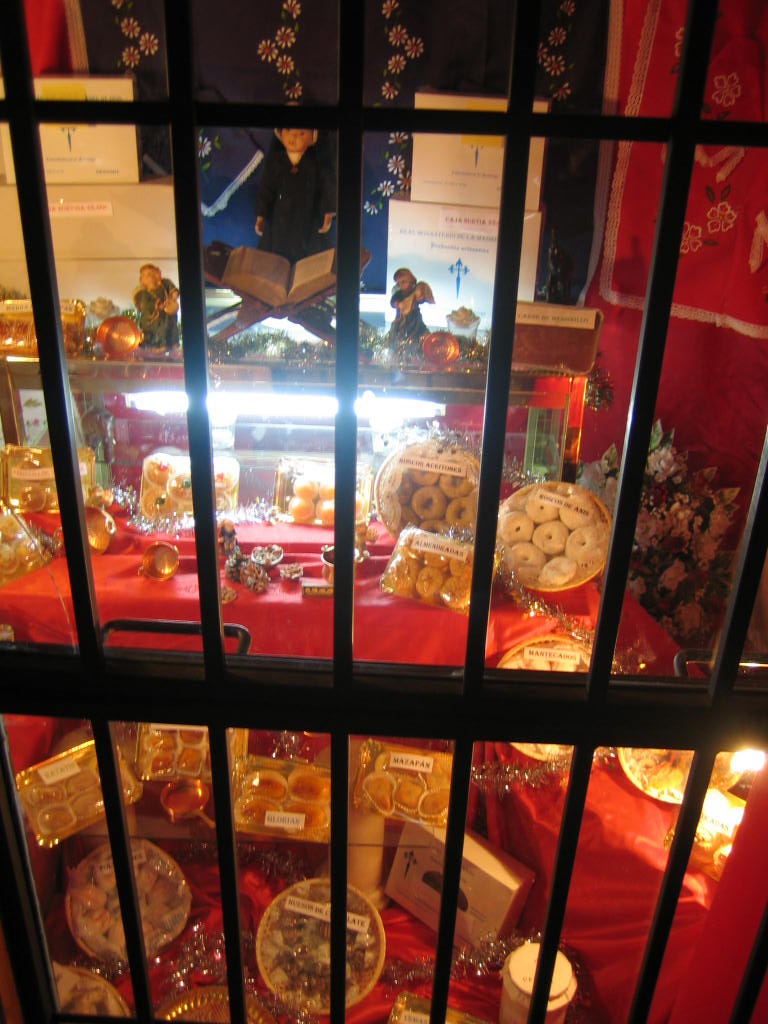
Christmas Sweets from the Convent of Las Comendadoras de Santiago

dulces conventuales
In the twilight, the door slowly rotated until it stopped to the impression of weight and age. Blanca timidly stepped forward and said “hola?”*. Silence greeted her from the other side of the door. She knocked once on the door. Again the wood magnified the sound and seemed to mock her paltry efforts to get attention in such an auspicious place of worship. There was still no response. The light was quickly fading, the lights of Granada were streets away and the sound of the evening shoppers was now a distant memory. In this half-light we found a doorbell located to the left of the doorway. Its shrill note seemed out of place in this place of quiet prayer. Momentarily a frail voice came from the other side of the door “que quieres?” (“what do you want?), this greeting sounded more like an accusation to the shoppers.

The torno at the door of the convent.

A month earlier… in November this year, Amanda Hesser wrote an article on the Thermomix for the New York Times. In this she explained the somewhat “counterintuitive” marketing strategy used by the firm. The product is not sold in shops, it is sold through introduction (somewhat like Tupperware) and the US supplier was less than forthcoming with information. To summarise, she thought the service was bad. Up until yesterday, I would have agreed with her that this was certainly unusual customer service.

In Spain, there is a long tradition of nuns producing sweets. The “dulces conventuales”, whilst not specific to Andalucía, are more important here due to the number of convents and range of sweets that are produced. Two historical facts need to be examined in understanding the development of these sweets.

[i] Firstly, Granada was the last Moorish kingdom to be reconquered by the Catholic Monarchs. In order to celebrate this throughout the Christian world, from the moment of the victory both civil and religious authorities worked to Christianise the city. This was to such an extent that a number of years later, the archbishop of Granada had to put a break on the construction of religious communities. Nevertheless, by the end of the 16th century, there was approximately 1 religious person for every 30 inhabitants, or 622 nuns and 585 monks.

A knight of Santiago... a long way from sweet making.

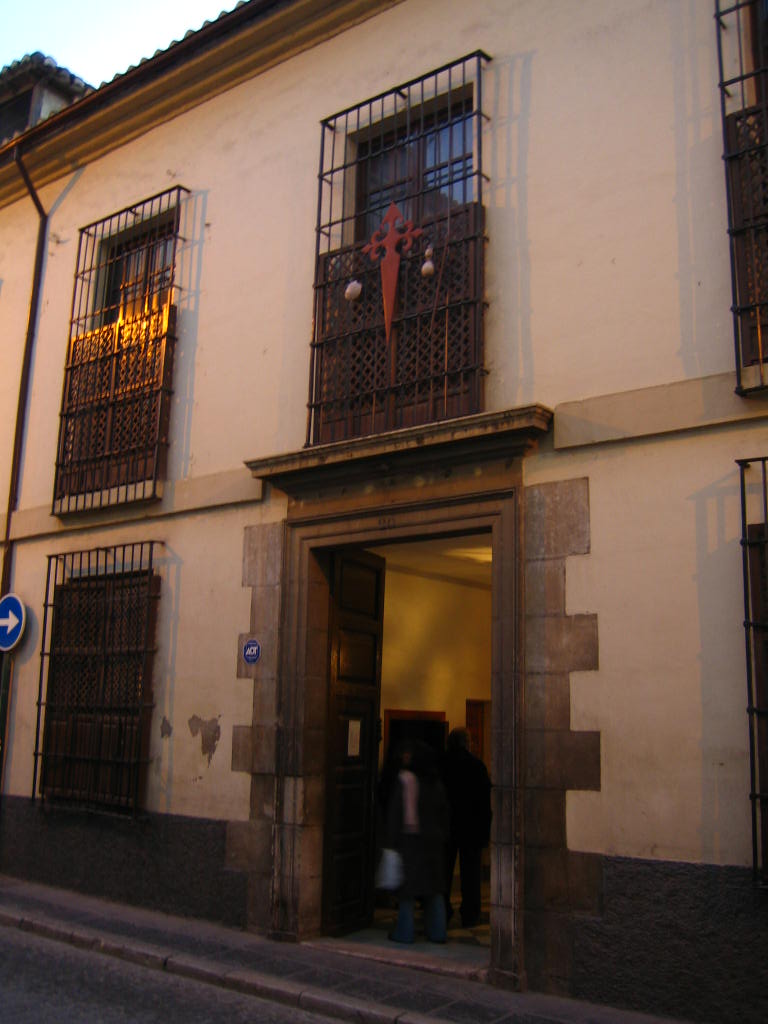
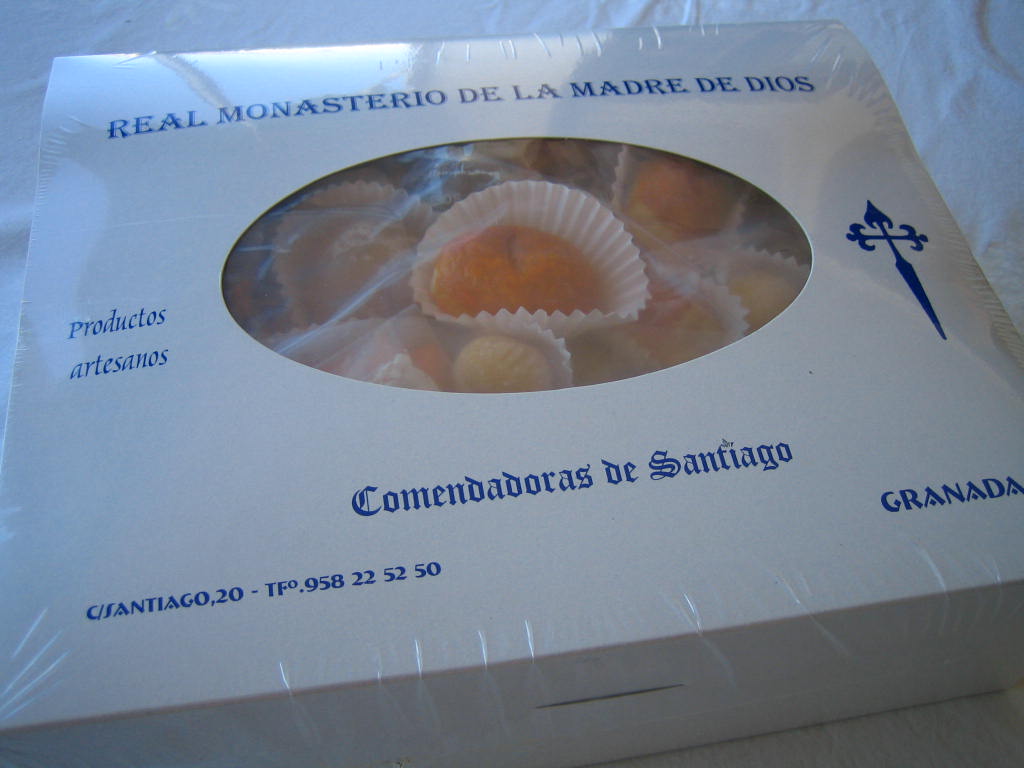
One of the monasteries that was founded was called “El Monasterio de la Madre Dios” (by the full name; Real Casa de la Madre de Dios, de la Orden de la Caballería de Santiago de España; known as El Convento de las Comandoras de Santiago (The Convent of the Commanders of Santiago)). It was opened by Queen Isabella in 1501. The Order of Santiago itself dates back to 1175, when it was founded by Pedro Fernandez de Fuenteencalada whom, along with 12 other knights of the order, wanted somewhere to protect his wife and children whilst he was fighting the Muslims. Today live 20 nuns in the monastery, 11 of whom come from India.


The second fact that must be considered is the [ii] “desamortización” (disentitlement). This is an economic process that ran in Spain from the end of the 18th century and culminated in the middle of the 20th. It consisted of putting on the market, through means of public auction, the non-productive lands and wealth that were in the hands of the “dead hands” (typically the church and religious orders that had accumulated them through donations and wills). The aim of the desamortización was to grow the national wealth and develop a bourgeoisie middle class of landowners.

[iii] The process of desamortización was used to its fullest by Juan Álvarez Mendizábal, the first minister of Isabel II of Spain. Isabel II proclaimed queen at the age of 3 after the death of her father Fernanado VII. Her accession was disputed by her uncle Carlos María Isidro de Borbón, whom, citing the law (Ley Sálica) that there could be no female heir to the thrown, claimed the thrown for himself. During the war that followed; the First Carlist War (1833-1840), Isabell came to represent the liberal, moderate “nuevo orden”, whilst her uncle, the traditional, religious “antiguo orden”. Mendizábal sold many religious lands in order to finance Isabell’s victory. It is said that the loss of these lands and wealth forced many convents into the production of “dulces convetuales” and sowing in order to earn money.

Most of the recipes are egg based. Convents are often donated a large amount of egg yolks from surrounding wine producers who use the whites during the clarifying process. Additionally, Irene tells me that there is a strong tradition in the south of Spain of gifting eggs to the convents in order that they pray for no rain on wedding days. Blancs and I didn’t do this, but it didn’t rain.

dulces conventuales
The nuns of the cloister of Santiago are famed for their candied and preserved fruits. There are no written recipes. The sweets are made from memory, based upon recipes that have been maintained over centuries. There combine a cultural and gastronomic legacy and it is said that only the patience and devotion of the nuns can bring out the flavour of the sweets.

Nevertheless, here is a recipe for “Glorias”…

Ingredients:
1 kg ground almonds
1 ¾ kg sugar
Zest of 3 lemons
1 kg Water

Mix the almond, ¾ kg sugar and lemon. Make a strong syrup by heating the water and sugar. Pour into the almond mixture. Beat until the mixture doesn't stick to the side of the dish. Once cool, make into little balls and cook in the oven until golden.

The nuns of Santiago live by a rule that they can not see people; this explains their unique form of salesmanship. At a more secular level, Ferran Adria swears by the Thermomix and there are approximately 200,000 sold every year in Spain and Italy. Whether it’s the mix of religion, history and economic reform or just something in the water… either way both have immense success in Spain.

¡Feliz Navidad!

Vocab builder:
- escarchada – candied
- confitura – preserved
- rosco – ring-shaped cake
- bollos – bread rolls
- erario – treasury
- subasta – auction
- avituallamiento – provisioning
- lote – plot of land
- puja - bidding

Sources:

[i] Lola Quesada Nieto “Dulces de los Conventos de Clausura de Granada y su Provincia”
[ii] Wikipedia http://es.wikipedia.org/wiki/Desamortizaci%C3%B3n “Desamortización”
[iii] Ramón Tamales y Antonio Rueda “Introducción a la economía española” (26ª edición)

* We have since found out that the traditional greeting is an Ave Maria. This may explain the reception we met.

Monday, November 14, 2005

Los Piononos de Santa Fe

Piononos de Santa Fe


You could easily drive through the little town of Santa Fe without realising its historical significance.
- This small town of about 13 thousand (located about 11 km from Granada city) was built in 1490 by Isabel and Fernando as the base camp for their assault on Granada, the last Moorish outpost on the Iberian Peninsula. It was strategically built blocking the Río Genil and hence communication between Granada and North Africa.
- It was here that the monarchs signed “Acuerdos de Capitulación de Santa Fe” (25th April, 1491). This was the truce wherein Boabdil (last Nazarí king of Granada) agreed the handover of his palace and city. Later, whilst leaving the city, Boabdil looked upon Granada for what would be the last time; he began to cry. In what is one of Spain’s most poignant quotes, his mother said llora como una mujer lo que no has sabido defender como un hombre (to cry as a woman for that which he could not defend as a man).
- In what was a busy year, the Monarchs also signed the other “Las Capitulaciones” on 17th April, 1492. These named Christopher Columbus the “Major Admiral of the Ocean Sea, Viceroy and Governor General of the Discovered Lands” and finaly approved the financing of his trip to discover an alternate route to the Indies.

boabdil - called el chico
Besides visiting the town for its historical significance, you can enjoy its culinary achievement; Piononos. This pastry is named in honour of Pope Pio IX (1792-1878); pope for a record 31 years and often lampooned by his Italian name Pio No No (wikipedia explains that he was considered quite conservative).

I had eaten Piononos loads before and never been wowed (upon reading this, local outrage may cutoff my future blog contributions). Their home rightly changed this opinion, but probably means that I’ll only ever eat them in Santa Fe. They are truly delicious; a custard filled pastry topped by burnt sugar.

Double risk on my point… we haven’t yet tried the recipe and it is translated… Blanca explains that this is basically a double recipe; one for pastry cream (creme patissiere) and the other for genoise.

For the pastry cream:
¼ l milk
200 g sugar
2 eggs
40 g soft flour
½ tsp lemon grated
For the biscuit:
3 yolks egg
5 whites egg
60 g sugar
80 g cornstarch
2 sp cold milk
1 cup rum
25 g cinnamon in dust

Pastry cream is a very versatile cream used in many cake and pastries. It is a thick custard cooked on the stove from milk, eggs, sugar, flour and cornstarch (as thickener). For the cream – boil the milk, sugar, cinnamon and lemon. Remove upon boiling. Beat the eggs and flour. Add the boiling milk. Return to a medium-high heat and whisk until it comes to the boil. Cool with a plastic wrap to prevent a skin from forming.

For the biscuit – beat the yolks with the sugar and milk. Heat and add the cornstarch. Beat the eggwhites until they peak. Add the eggwhites to the mixture. Pour onto baking paper in a linear fashion (approx 2 inches). Place in the oven for 10 minutes. Make a syrup with water, sugar and soak the genoise. Spread the pastry cream and roll. Sprinkle sugar on top and toast in the oven. Serve cold.

Vocab builder:
Empapar – to soak
Almibar – syrup
Almidón – cornstarch
Canela – cinnamon
Rallar – to grate
Regar – to irrigate
Placa - numberplate (you may well wonder how this made it into the vocab)
Harina pastelera – soft flour
Capitulación – capitulation
Rendición – surrender
Virrey – viceroy

Broadband connectivity in the South of Spain obviously felt that I was a little bit ahead of myself by blogging early last October. This is the reason for my one month absence. Hopefully this blog signifies service recommencing as normal.

------------ STOP PRESS "CASA YSLA Y LOS PINONOS" ------------

I have just been on the web to see if I could find a picture of the pastry shop where we had the famous Pionono. Not only did I find a picture, but a lot more about the Pionono. The pastelería is called "Casa Ysla" and is none other than the originator of the Pionono.

The history is amazing... in 1897 Ceferino Isla González (intern to Manuel “el Gallego”) opened his own store on Calle Real, Santa Fe. He was very devoted to the Virgin and wanted to pay homage to Pope Pius who, in 1854 had issued the infallibly defined the "dogma of the immaculate conception" (essentially that Mary was free from original sin). In this way, he decided to create a new pastry. The aim was to not only carry the name of the pope, but also his likeness; cylindrical and somewhat chubby.

In 1916, the King (Rey D. Alfonso XIII), whilst visiting a friend on a nearby farm, ate some Piononos for his afternoon snack. He was so taken by the delicious flavour that gave the title of official providers to the Royal House to Casa Ysla.


... Spain... go for the pastry and stay for the politico-religious history.

Technorati Tags:

Friday, October 07, 2005

In Season in Spain

Well, it's been a long time. Just over a month. I feel like I'm talking to an old friend that I haven't seen since school. Either way, I'm back on the blog. It's going to be a little intermittent over the next while, we have made the move to Spain, but are still waiting the arrival of our the rest of our flat from London. I managed to forget our camera so this is going to be a pictureless blog.

For this blog, I thought I'd do some Spanish homework at the same time as researching a little bit about the food in season at the moment. The following list is from Simone Ortega's very good "1080 Recetas de Cocina". They are all the ingredients in season at the moment. I have asterisked those that I needed the dictionary to translate...

Verduras (vegetables)

Champiñon de París = button mushrooms
Acelgas = chard or beet*
Zanahorías = carrot
Puerros = leek
Lechuga = lettuce
Cebollas = onion
Cebillitas francesas = shallot*
Remolacha = beetroot*
Coliflor = cauliflower
Espinacas = spinach
Lombarda = red cabbage (based on google image search only)*
Repollo = cabbage*
Apio = celery
Tomates = tomatoes
Pimientos verdes y rojos = red and green peppers
Alcachofas = artichoke
Calabacines = courgette
Berenjenas = aubergine
Judías verdes = green beans
Calabaza = pumpkin ... or "to fail"*

14 of 20 without using the dictionary

Pescado y mariscos = fish and shellfish

Merluza = hake*
Pescadilla = whiting*
Rape = monkfish
Lubina = sea bass
Lenguado = sole
Gallo = rooster* (eh, not really a fish?)
Breca = sea bream? courtesy of www.fishbase.org via google images Pagellus erythrinus*
Rodaballo = turbot or flounder*
Congrio = conger eel*
Sardinas = sardines
Boquerones = anchovies*
Besugo = sea bream*
Pez espada = sword fish
Calamares = squid
Cigales = crayfish (dublin bay prawn)
Gambas = shrimp
Chirlas = something like baby clams, may not have an English name?*
Langosta = lobster
Langostinos = languistine
Bogavante = hake*
Carabineros = a little crustacean, this is a somewhat vague translation from blancs*
Almejas = clams
Mejillones = mussels
Ostras = oysters

13 of 24 without the use of dictionary*

Frutas = fruit

Piña = pineapple
Manzanas = apples
Peras amarillas = yellow pears
Peras de agua = water pears
Limones = lemons
Naranjas = oranges
Pomelos = a pomelo?*
Melón = melon
Uvas = grapes
Ciruelas = plums
Chirimoyas = chirimoya*
Plátanos = bananas
Membrillos (desde medio mes) = quince (from the middle of the month)
Aquacates = avocado
Kiwis = kiwis

13 out of 15 without using dictionary. Both pomelos and chirimoyas are new to me, but I have eaten both previously... if you know what I mean.

Carnes = meat

Pollo = chicken
Gallina = hen
Conejo = rabbit
Vaca = cow
Ternera = veal*
Cerdo = pig
Cordero = lamb
Mollejas de ternera = fried sweetbreads*
Cochinillo = suckling pig
Perdices = partridges*
Liebre = hare*
Codornices = quail*
Becada = a game bird, but I don't know what the English name is
Faisán = pheasant
Aves acuáticas = aquatic birds?
Venado = veniso*
Jabalí = wild boar*

8 of 17 without dictionary

A few things that the above tells us:
- I understand about 63% of the food in Spain. That makes me a C student, I reckon that is about right.
- I have learnt more fruit and vegetable names over the past years of coming to Spain (87% and 70% respectively). This could either point towards their strong role in the mediterranean diet or, maybe you shouldn't trust my translations.
- Meat and fish let me down (47% and 54% respectively). Alan Davidson would be disappointed. I guess any low cholesterol diet would have mixed feelings on it...

Either way, you can expect the above to feature heavily in recipes over the next month... I'm now going out for something that I can understand; tinto de verano y tapas.

Technorati Tags:

Wednesday, April 06, 2005

cordoba - go for the salmorejo, stay for the ajo blanco

gazpacho
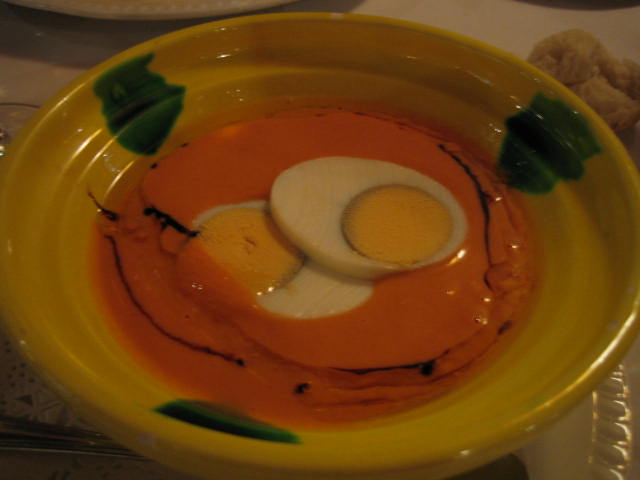
salmorejo
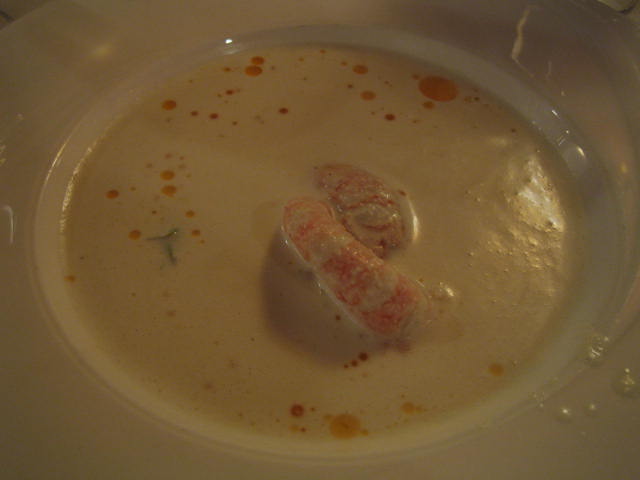
ajo blanco


last summer i spent 4 weeks at spanish school in sevilla. it was a great time; blanca was doing work experience at ferran adria's second restaurant - el bulli in hacienda benazuza. i was able to regress for the month, forget london and working life. the first day, i arrived at school certain of my bohemian credentials - extended vacation, shorts everyday, i didn't have my duffle coat because it was too hot ...

i quickly realised that the school had an ongoing exchange program with many european schools and that the majority of my colleagues were 19 year old philosophers and dreamers. despite being only 29, i was soon revealed to be the oldest in the school. matters got worse during the open sessions where we would talk about ourselves in spanish. my demographic facts were drastically at odds with my bead wearing colleagues ...

- not only had i contemplated a job, but i'd actually gone out and got one
- i had in fact held onto that job for 8 years
- i owned an apartment in london (i didn't mention the mortgage)
- i was married
- i supported franco (this isn't the whole truth, but to the eyes of a student, i think this is how i seemed)

i was given up as a lost cause when, one day, i had to make a presentation on spanish life. i came to the part where i would talk about food ... my professor, a born and bred sevillana, sat forward eagerly waiting to hear of my love for their food. she was, shall we say, disappointed when i contrasted it to the rest of spain; i confidently stated that andalucia was the worst and that the restaurants were over priced and unexciting. if you have been to the south, you may feel that this is unjustified, but there are elements of truth ...

- the best food in the south of spain is to be found in homes, not in restaurants.
- the best food outside of the home is the tapa. for variety, use of local produce and ingenuity they are unsurpassed. the southern style of "comer de pie" (eating on foot) is the real reason that there are not many "classical" restaurants.
- and, if i'm honest, after 4 weeks in sevilla, it is true that we were a little bored with just good tapas and were thirsting for some other food*.

ever since our gastro experiences in sevilla, we have been eager to take any opportunity to search out the great food of the south. with this in mind we took a daytrip from guadix to cordoba to have lunch with one of blanca's cousins; antonio-luis. this is a 400km roundtrip and may seem a little extreme, but cordoba is the renowned home of salmorejo (thick tomatoe soup) with which i had fallen in love with last year in sevilla. the city is a world heritage site with a beautiful mosque / cathedral (mezquita) and jewish neighbourhood (la juderia). we went to the incredible bodegas campos restaurant. this is one of the best restaurants i've been to in spain.

in writing this blog, i am using as reference "gazpachos, sopas y ajos blancos" (enrique mapelli lopez), my spanish isn't perfect, but i think this means "gazpachos, soups and ajos blancos". i am conscious of the fact that i am reading a spanish book to write an english blog as i sit on a train in tokyo, but hey, i won't let the details get me down.

three soups, based around the gazpacho concept, form the trinity of cold andalucian soups. they share the same core ingredients; bread crumbs, garlic, olive oil, water and salt. if anyone gets the chance, read the chapter that breaks down each ingredient, it is the closest thing to culinary poetry that i have ever read (mostly because i don't understand a lot of it). i will attempt to summarise.

each ingredient brings its own specific attributes to the soup. their history in combination goes back as far as the roman legions and columbus who all carried similar provisions. white bread for sweetness, thickening, energy and digestibility. garlic for flavour and medicinal properties (i.e. working as an antiseptic). olive oil for flavour, texture and health benefits. water as these soups serve the purpose to rehydrate and refresh from the hot andalucian sun. salt to bring out the flavour, replace lost body salt and build the appetite for the next course.

typical gazpacho andaluz contains:
- 100g bread crumbs
- 4 teeth of garlic
- 2dl olive oil
- 2dl vinegar
- salt
- 100g cucumber
- 100g green pepper
- 250g tomatoes
- some cumin
- 1l to 1.5l of cold water
in a mortar mash the bread, garlic, cumin, salt and olive oil and leave to absorb for 30 minutes. add the remaining ingredients and water to taste. for garnishing use 100g cucumber, 100g green pepper, 100g tomatoes and 100g crudités all chopped. this recipe is somewhat vague, but, in spain there is a saying; there are as many gazpachos as there are gazpacheros. i'm not going to be too anal about the details here.


salmorejo is made all over spain, but heralds from cordoba. a typical recipe contains:
- 10 red tomatoes
- 1 slice of bread
- 4 teeth of garlic
- 0.5l olive oil
- 1 egg yolk
- salt
- 0.25l of water
mix all in the blender and serve with an egg in quaters and some olive oil drizzled on top. you could also serve this with ham or orange slices on top.


ajo blanco (white garlic) most likely originates in malaga.
- 200g almonds
- 4 teeth of garlic
- 2 slices of bread
- 0.5dl of olive oil
- 0.5kg of ice
- salt and pepper
scald the almonds in hot water to get rid of the skin. grind all the ingredients together. pass through a colander and add water to thin. for garnish, 20 pealed grapes and 20 balls of melon. cordoba has a reputation for serving with apple slices. the ajo blanco in cordoba had shrimp ... this was the best that i've ever had!

* i don't want to give anyone the impression that there is no good food in sevilla or andalucia. in fact, 90% of the fun is in finding the great places. for anyone visiting sevilla i recommend bar eslava it saved us more than once!

Monday, April 04, 2005

mariscos en la playa

gambas a la plancha

from the 4am coolness of london we spilled out into the midday andalucian sun. pale, tired and shrinking from the sun we stumbled around the airport looking for our friends. out of the bright light appeared fernando and valerie; tanned, tall and healthy after a week scuba diving in san jose. they led us by the hand to their car. they had suggested that we stop over for an evening and go for some mariscos (shellfish) by the sea upon arriving. this wasn't merely food, this was a mission of mercy.


there are meals that are emblematic of a place, it becomes impossible to think of one without the other. i think of new year 2004 and oysters from the english market in cork, a yuacatan road cafe for empanadas and eating sukiyaki with taro's family in tohyama. this lunch has entered the list as representative not only of great food, but also of southern spain. we went to alquean (el merendero de la playa) [note: i'm not all that sure if this was truly the name of the restaurant. in fact, in the spanish way, i'm not sure if it even has a name. it could have been valerie just appeasing my anal city need for details and names]. to call it a restaurant is probably an overstatement, it is more of a surf shop from the outside. along the seafront is a thin line of fishermen boats. the owners will go out every morning to catch the days fish. these are served throughout the day only 20m away in the merendero. food doesn't come any fresher than this.


you enter the restaurant through a plastic covered outdoor section. a dark bar leads you to the fish counter. from here you choose the fish that you wish to eat. considering our state of sunshock, fernando and valerie took the initiative and ordered a suitable range of shellfish; gambas (shrimp), cegala (see below ... it is a crustacean; shrimp on steroids), concha dulce (similar to clams), pulpito (octopus), huevas de pescado (deep fried fish eggs), boquerones fritos (deep fried anchovies). the suitably crusty cook / waiter / owner (?) willingly took the order and gave us a ticket to claim our food.


we quickly moved to the table, all of the usual icons of spanish seafront dining were present; paper tablecloth, napkins in alcohol sponsored plastic dispenser, ashtrays and lemon wipes. we quickly added the obvious ones; basket of bread, borrowed cigarette, bottles of beer. at this point fernando was probably surprised that i started photographing the most unusual things. considering the beautiful surroundings, i seemed intent on photographing only the food that was served to us. in addition to this, i was still hungover from the preceding night and still don't speak excellent spanish, this has all probably reinforced the impression of me as being a bit of a simpleton ... well you have to admit that some meanings cross cultural boudaries with amazing clarity.

we started with an typical andaluz dish; migas. this consists of breadcrumbs fried with chorizo sausage. it's been a favourite of mine since i first stated going to the south.


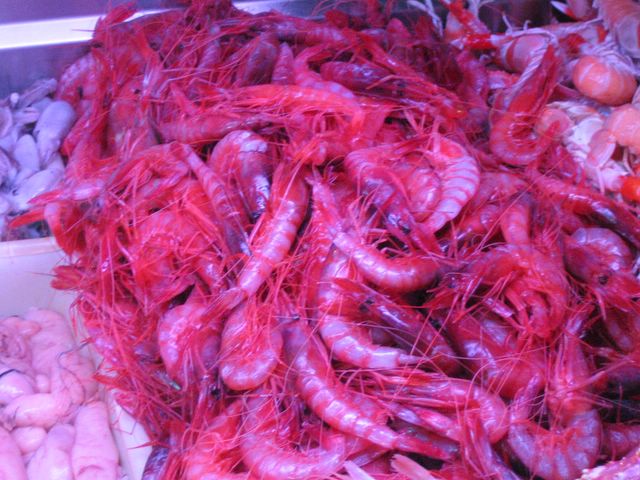
next came the gambas rojas (red shrimp). there are many different ways to cook shrimp; boiling and frying among the favourites. despite the fact that blanca has a massive amount of spanish cook books, it is amazing how little reference there is to this most traditional dish.

i found some interesting information at grupo gastronomico gaditano (a cadiz based site). this site has a particulary nice scientific approach:
- it recommends shellfish outside of the months may to august (the month with R rule) during which the reproductive cycle takes place. shrimp will lose their weight, flavour, texture
- boiling is recognised as the best form of cooking with some "simple techniques" required...
- the water used to boil should be at the salinity of the sea.
- most interestingly (really only applying to the larger crustaceans), as a rule, add live shellfish to cold water and bring to the boil. add dead shellfish to boiling water. this fairly cruel approach ensures that the shellfish do not "release their legs", meaning that they will actually loose their legs and hence flavour / meat (this took some time to translate; the only other similar quote on the web relates to jumping kangaroo, but i don't think the spanish typically cook this on the seafront in salted water)
- for duration, it recommends that gambas are put into boiling water and once it returns to the boil they are ready.

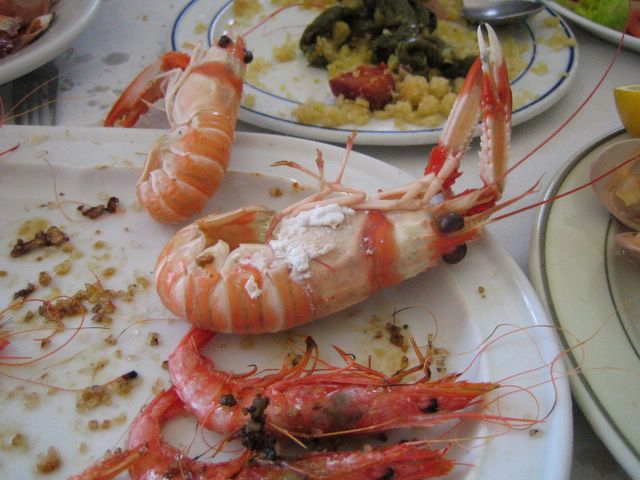
... ironically and perhaps to the disgust of the good people of cadiz, we had gambas a la plancha (literally on the iron) with salt. they are fried in olive oil and salt for about 2-3 minutes. valerie taught us how to eat shrimp heads with style.

and ... excuse the pun; just when i thought it was safe to get back in the water, came another gastro mystery ... the next dish came; cigala; impressive, but slightly overcooked. after quite some time searching i eventually found a translation ... cigala meaning crayfish in english. blanca wasn't convinced and whilst the wikepedia photo seemed like a good match, she recommended that i consult the oracle of all things fishy; alan davidson's north atlantic seafood.


a cigala realises that i can't translate its and decides to made a bid for freedom ...


he settled the debate in favour of, oddly enough, the dublin bay prawn. in appearance this matches the cigala from spain; the crayfish, or spiny lobster, does not have the large front claws of our cigala (wikepedia has the wrong photo) ... alan mentions that the dublin bay prawn gets its name from the fact that irish fishermen, having accidentally caught the prawn, would sell these on the black market (not being regulated like normal fish) to vendors such as molly malone ... say no more.


last came the house specialty; deep fried anchovies (boquerones fritos). these were excellent and we agreed the best dish of the day. most simply brushed with lemon juice and dusted with flour. fried for a couple of minutes until well golden.

Friday, April 01, 2005

3 ways to eat a shrimp's head

first i must thank two people for making this blog possible; valerie who showed us the 3rd and by far more glamorous way, and blanca who gave me the incentive by saying "the head of shrimp is the only thing that steve is afraid of eating". pride is a terrible thing and the shrimp have suffered all the more for it. second, i must urge only intrepid eaters to continue, this is not for the faint hearted ...

as a shellfish (mariscos), the shrimp is a crustacean (as opposed to molluscs; mussels, clam, squid etc.) and shares this family with lobsters and crabs. they date back 200 million years so we should at least understand something about them before we eat their heads...


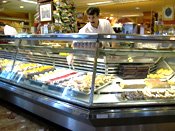
shrimp in the natural spanish habitat; the seafood counter ...


they are what we call a "decapod" (well, what i now call a decapod) meaning they have 5 pairs of legs. like the rest of the crustaceans, they have a forward part (head or cephalothorax) and the rear portion (tail or abdomen). the head is actually quite a bit more than just a head, it also includes the main digestive, circulatory, respiratory and reproductive systems. mcgee likens it to the equivalent of our head and trunk put together. the tail is basically a swimming muscle that moves the back end plates. all of this means that whilst i was originally turned off by the idea of eating a shrimp's head, i'm horrified by the idea of eating their head and all essential organs ... good.

many people will never be served a shrimp with a head on. the reason for this is that the liver (digestive enzymes) are contained here and breakdown quickly once the animal is killed. this spoilage can be reduced by removing the head or keeping the shrimp on ice. basically, the further away from sea you are the less likely you are to get a shrimp with head attached. this part of the body is also the richest in flavour and therefore considered the best part of, especially, lobsters and crabs.

i had my first plate of real 'mariscos' (shellfish) at a wedding in spain. as an irishman it was odd enough to be eating fish, let alone having to peel their shells from their backs and eat them. i was quite proud of myself as i ate through the plate. strange thing that i noticed was that despite not eating the heads, there was no pile building up on my plate. i looked around and noticed that blanca was hoovering all the heads from the plates around us. with her lips pursed against the "neck" of the head and a sharp intake of breath, she was sucking the insides out. i'm not going to expand on this further; it was a bad to witness as it was to recall and write. samcooks has written a good article on the joys on "sucking shrimp head".

in spain it is very difficult to find a shrimp (gamba) served to you without its head on. the main reason for this is that the head will retain much of the flavour of the shrimp whilst being cooked. even in spain, a land dedicated to eating seafood, it is not completely normal to eat the head of shrimp. spain is the second largest consumer of fish in the world. i have had the pleasure of eating fish in japan; the largest consumer of fish...

at the end of 2004 we were with some friends in a sushi restaurant in tokyo. when it came time for the heads of the shrimp to be addressed, the chef thankfully took the burden of choice away from us. he grilled them in a mini oven at the side of the kitchen. he then opened the heads and served them to us outside of their shells.

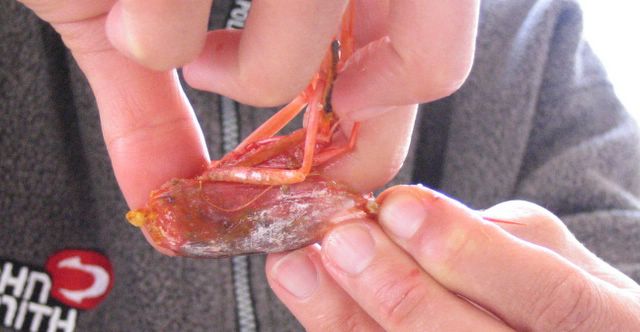
valerie recently showed us the french way of eating shrimp head. as it is french, it far more delicate and refined. i have now adopted it as my chosen method of eating shrimp head ... i call it the grasp and pull technique:

step 1 - the "grasp". take the hands of the shrimp (what i fondly call the “hands”; the 5 pairs of crawling appendages on the head), hold the nose (the hard nub of exoskeleton above the eyes)


step 2 - the "pull". pull the lower portion of the head from the hard upper shell. the inner organs will be revealed. eat in the manner you see fit …


note: shrimp are categorised as warmwater, coldwater or freshwater. we were eating warmwater mediterranean red shrimp (gambas rojas). many shrimp died in the writing of this blog, i owe them all a debt of gratitude.