Thursday, June 30, 2005

Sansho & Fate

There is a word for the situation whereby something stumbled across for the first time appears on a seemingly frequent basis thereafter. I can't remember it. I will call it "sansho".

Sansho is the name of the herb pepper that we had with Unagi recently ... later, that same day, across the other side of town we came across a sprig of the original - from the kinome shrub.


As if in a scene from a culinary Yimou Zhang movie, the kinome sprig is caught midair by the deft hand movement of Steve's dining companion ...

A little bit more digging revealed that the kinome shrub actually produces szechuan peppercorns (these are the shells surrounding the seeds). The uwajimaya site explains the taste as "being reminiscent of mint, basil with a hint of anise" - I would say more than a hint. It also reckons that the pepper has a lemon-like flavour.

That's sansho for you!

p.s. if anyone knows the name for the sensation mentioned in the first line, please mail me...

Tuesday, June 28, 2005

inagi, unagi ... we all nagi

It’s hot in tokyo today. 88 degrees F with 58% relative humidity. The heat index is at 94f (10 degrees away from a dog heat stoke). We decided to shelter our meteorologically fixated minds in an unagi (eel) restaurant.


Although eel does not feature on the world’s healthiest foods site, it is regarded as summertime healthy in Japan. Three reasons abound:
- It is a good source of protein, calcium and vitamins A and E.
- Less scientific, but far more romantic, lore has it that eels are strong in order to make the journey from ocean upriver in order to breed – the things we do.
- Either way, it is thought to improve stamina and as a result it is most often eaten at the hottest times of the year. In fact, doyo-no-ushi (complicated, but something like 18 days before fall) is the day that the japanese traditionally eat eel. On this day food beginning with “U” is considered good for our health (ok, the least scientific of all reasons).

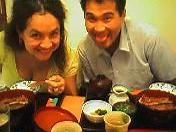
Grilled eel is a specialty in Japan. We didn’t see the cooking, but it seems to consist of 3 stages – over charcoal, steamed to remove fat and finally seasoned and grilled. We went for the typical unajuu or unagi donburi or unadon (basically anything you want). It is served on a bed of rice with teriyaki sauce over the fish. Much like the 4 steps to happiness that cocoichibanya recommend, the waitress recommended an interesting 3 styles to eating the unagi (she may have been getting revenge for having to cook the thing in 3 different ways):

Style 1: unagi with sansho

Actually, we didn’t know what sansho was. Thoughts ranged from fish salt to herbs. It turns out to be a powdered aromatic pepper.

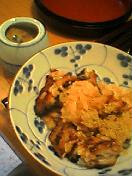
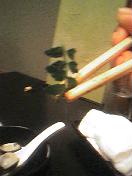
Style 2: unagi with onions, seaweed and wasabi

Not the best photo that was ever taken in Japan, but this was my favourite (syle not photo).

Style 3: unagi soup

Disturbingly enough Taro called this tea.
Friday, June 24, 2005

Tsukiji Cart Racing

Ever since my first visit to Japan back in October, I’ve wanted to get to see the famous fish market; Tsukiji. The hours of business (5am to 9am) have mostly precluded any visits. We were fortunate that a recent world cup qualifier (Japan vs. Bahrain) ran until 3am. A quick detour for Karaoke in Roppongi meant that we arrived at the market at about 6am … the sacrifices we make for our food!

The central wholesale market is the largest in Japan. It is a market for all food related products; fish, fruit, vegetables and kitchen utensils, but it is most famous for its fish. It is located in central Tokyo. It is one of the world’s largest and handles over 2,000 tons of fish everyday. Note: there seems to be some debate as to the largest in the world, we have given the award to Tsukiji. Fish comes off trawlers directly to the market and is sold out to the restaurants for the day’s dining.

Admittedly the timing may not have been best to capture the full culinary delights of the market. Nevertheless the alcohol in our veins made the adventure suitably surreal. A warning on the Japan guide website states that it “is a site where serious business is conducted, it is important for visitors not to interfere with the action by not bringing any large bags and not obstructing traffic along the narrow lanes”. The sight of 4 karaoke revellers weaving through the narrow lanes and dodging the trucks was probably not the most welcome to the local tradesmen. It was a good job that we didn’t read this prior to our trip. Being forewarned would have inevitably meant that we would have been far more likely to be injured.


Trucks at Tsukiji – courtesy of japan-guide. I would have taken a photo myself, but for the rush that I was in to safety.

We spent some time moving from stall to stall. I managed to buy a Japanese mandolin (the slicing kind) and tacky sushi teacup … you know, the typical drunken purchases you make a large fish markets. Taya had her photo taken with a bear while Taro and Matt played chicken with the Tsukiji carts. The trip reads like a hallucinogenic fantasy. The carts are fantastic; alone worth the visit. There is a junction in the middle of the market where all the local tradesmen seem to congregate in order to race each other. There are no traffic lights. Crossing this junction on foot feels like walking in between burning oil cans being wielded by demented tramps … with 2,000 tons of fish on their backs.

The revelation of the trip was the tuna. Although we didn’t get to see the tuna market (it is off bounds for tourists at this time of the year – thank god!). We did manage to see into the cargo-in bay from a safe distance. Blue Fin Tuna will grow to approximately 6 ft (2 m) and weigh about 300 lb (135 kg). It can live up to 40 years, but is mature at 8. They can be found in both the Atlantic and Pacific in waters as deep as 3000 feet. The can swim at up to 45 mph, meaning that they could cross the Atlantic in 60 days. The meat is prized and can sell for as much as $30,000 for a large fish.


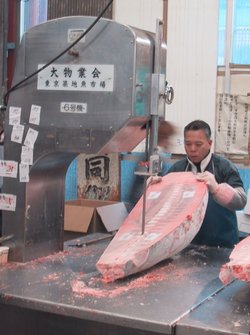
Frozen tuna being slides – courtesy of Wikipedia.

There are many interesting facts about tuna (courtesy of wikipedia). It is one of the few fish that is warm blooded. Most fish are cold blooded and as assume the temperature of the water surrounding. This gives them very little range in terms of their ability to travel. Tuna has a higher oxygen carrying ability than any other fish species. As a result, the flesh of tuna is pink (unlike most white flesh ocean fish). Bluefin can use muscle activity to actually increase their body temperature above the surrounding waters.

We had what is rumoured to be the best sushi in Tokyo; breakfast at the market. For 600 Yen I had fantastic tuna steak with tea. At this point we were all beginning to feel a little worse for wear by the end and decided to leave at about 8am.


The parting shot – leaving the market with shopping and heads in our hands. This is the only photo we managed to take (at least that I'm allowed show) ...

Sunday, June 05, 2005

the steve beater

Fish chowder with aioli (or, a study in the male ego; or, Saffron Scented Seafood Soup with Fennel and Aioli).


there is pain in that aioli ...

Preparation of Aioli…

B: “Steve, can you mix the eggs; use the electric or do it by hand”
S: “Sure thing, step aside little lady, I can do this by hand”
Steve starts beating. Holding the steel bowl awkwardly at an angle and struggling to make either a circular motion or a to and fro motion, in fact not knowing what motion to make.
B: [from the cellar] “I can hear that you’re not mixing correctly”
S: “You’re the cook – show me how”
Blanca demonstrates a very similar motion. As with most things, with the desired result
B: “OK, we’re ready for the oil, are you sure you’re ok?”
S: “Yeah, no problem, I’ve gotta learn how. Start adding baby!”
Blanca starts dribbling oil into the bowl
B: “MIX! FASTER. HARDER”
S: [inner voice] “Jeez, this is surprisingly sore, how much longer must I go on? I can’t ask Blancs, she does this everyday. Keep mixing Steve, I’m sure we’re nearly finished”
B: “MIX. FASTER. Stop holding the bowl at the angle, just MIX”
S: [inner voice] “It hurts. My arm is sore”
Steve’s face is red, his pace is visibly slowing. A strange whimpering noise is coming from behind his gritted teeth
B: [most likely feeling sorry and not wanting her husband to have a heart attack] “You’re doing great, this is going really well. Do you want me to take over?”
S: [weakly] “No I’m fine”
B: “OK, last phase, I can add more oil. Keep mixing”
S: “I want my mummy”
All pretence is lost
B: “That’s great, OK stop mixing”
Blanca has to coax Steve from his mixing. Gradually his arm stops moving and his jaw slackens. He hasn’t taken a breath in the last minute. He holds his head up high. Once out of sight his arm raises above his head, he holds it feebly with his left arm. He should have read the science before dismissing the kitchenaid.

The Science behind the Pain


You will remember there are (somewhat controversially) 5 mother sauces; brown, veloute, béchamel, hollandaise and mayonnaise. Briefly, the former 3 are cooked with roux and the latter 2 are emulsions. Of the latter 2, mayonnaise is made from cold and hollandaise (made from butter) is cooked. Aioli with French / Catalan origin is really a variation of mayonnaise, the recipe that we used is as follows:

- 2 organic egg yolks
- 1 tsp Dijon mustard
- 2 garlic cloves, crushed
- 1 tbsp lemon juice
- ½ tsp salt
- ¼ tsp white sugar
- 150 ml sunflower oil
- 150 ml olive oil

Emulsion comes from the Latin “to milk out”, as McGee states, this can be associated with the fact that the end product will deflect the path of light through the sauce and thereby give a milky appearance. These sauces are formed by the mixture of two liquids that do not normally collide. The most common emulsions are made of oil and water; mayonnaise and milk for example differ in the proportion of oil (70% to 4%).

Oil and water, when mixed together will always separate in order to reduce their surface tension. These can be forced apart, but will naturally return to separated positions in order to again reduce the tension. Egg has the key role in maintaining this separation (we call them emulsifiers in this role). Since the 17th century, it has been recognised that egg yolk will surround the oil molecules and thereby reduce surface tensions.

To the preparation – the quantity and timing of the additions is key. Make sure all the ingredients are at room temperature. Place a bowl on a cloth to prevent slipping. First whisk the egg yolk, mustard, garlic, salt, sugar and lemon juice into a thick and creamy emulsion (of the water / fat content in the egg) and season. Mix both oils in a jug. Next add about one quarter of the oil drop by drop (dribbled) and beat vigorously. The timing here is important but simple – it is easier to separate “oil-in-water” if starting from a lower proportion of oil relative to water. At the point that your arm feels like it is about to fall off, you are ensuring that the oil is not rising to the top, but instead forming small droplets below the surface of the sauce. This is usually achieved where the volume of the oil is similar to the original water. What is happening is that the droplets have formed in such size beneath the surface that they in fact impede each other from rising to the surface and forming an oil pool. Taste and check the flavour – adjust as required.

You can then add the remaining oil in larger quantities (tablespoon amounts). The tiny droplets beneath the surface act as a mesh and breakdown the incoming particles to dimensions of their own size. The latter stage need not require as fierce mixing as the main purpose is to distribute the oil amongst the mix.


photo came blue ... not very artistic or appealing, but you get the drift ...

Aioli is a perfect companion for fish soup. We had family staying with us recently; joyfully we substituted a night of home cooked food for a night at some dodgy musical. Cooking from books for cooks volume the rest of the soup is fairly straightforward:

- 4 scallops
- 8 tiger prawns
- 125 g monkfish tail
- 2 tbsp olive oil
- 2 garlic cloves, crushed
- 1 onion chopped
- ½ fennel bulb chopped (diced)
- 1 small carrot, chopped
- 1 glass white wine
- 750 ml fish stock
- 2 ripe tomatoes, seeded and finely diced
- 1 potato diced
- Large pinch of saffron threads
- 4 tbsp lemon juice
- Salt, pepper, cayenne pepper
- Fresh dill for garnish

Warm the oil in a pan over med heat, add the garlic, onion, fennel and carrot and cook stirring until soft. Pour in the wine and reduce. Add the stock, tomatoes, potatoes, saffron, bring back the boil, then simmer until the vegetables are tender. Stir in lemon juice and season with salt, pepper and cayenne pepper. While the soup is simmering make the aioli. To finish adjust the heat so that the soup is barely simmering. Add the fish to the hot broth and poach very gently for approx. 5 minutes. Ladle into warmed bowls, making sure the shellfish is evenly distributed (a slotted spoon is very useful for this).
Serve at once garnished with dill sprigs and heaped spoon of aioli.

Thursday, May 12, 2005

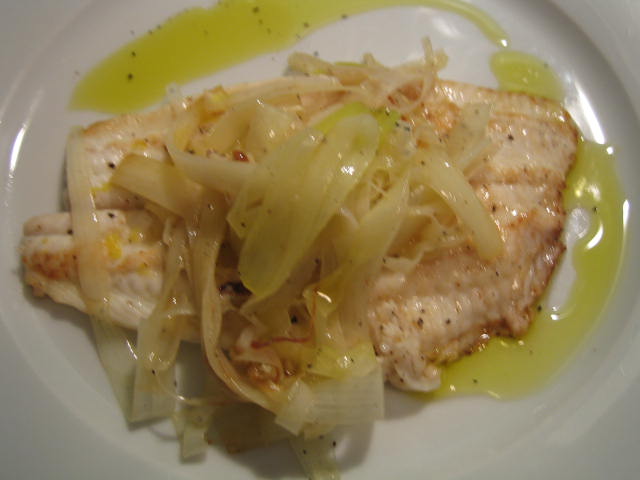
yes, i am a sole man...

dover sole... simply dover sole

a number of years ago, in her cordon bleu days, blanca worked at the much missed blagdens fishmongers off Marylebone lane. it was here that she introduced me to the joy of dover sole. well... we went for a birthday dinner one evening to the river cafe. she had made a delivery just that day. in honour of the delivery (and being a lot easier than having to make one myself) i selflessly ordered the sole. it was the tastiest fish that i thought i had ever eaten.

the cost of the fish has kept me away for a number of years, but when asked i will always say it's my favourite. it's been a torrid romance of denial. much like the girl that you fleetingly see at a disco or on a train and never see again... as if a restraining order had been put on you, or you couldn't afford the train.

indeed, if she was a girl, you would find her swimming in the seas of the mediterranean to the north of scotland. she is not the prettiest of romances; her pectoral fins are well developed and her eyes are ... well spaced.


ingredients:
dover sole
malden sea salt
leek
olive oil
lemon

julienne the leek and fry briefly in olive oil. alan davidson mentions that dover sole is one of the few fish that actually improves about a day or two after its death. in no small part attributed to a distracting tarte tatin last night, we cooked fish that was a day old. heat a frying pan with some olive oil. lay the fish down a briefly cook (1/2 minute). flip onto the skin side and cook for no more than a minute. squeeze lemon over and some salt. eat as soon as plated. this recipe is deliberately simple. sole, being one of the best tasting fishes, is best served with lemon alone. we find that olive oil is a great addition and add a nice edge of complexity to the taste.

this was so good that we cooked 3 fillets and then went back for the last. we ate this like it was chocolate dessert ~ off one plate and trying be honourable, but wanting it all to ourselves.


incidentally... i've been absent, but i haven't forgotten... leek, from the allium family (shared with onions and garlic) contains most of the healthy attributes of these vegetables. a high intake of allium is actually shown to reduce total cholesterol and LDL. it raises HDL at the same time. it is associated with reduced risk of prostate and colon cancer. note: onions and garlic both contain more of the healthy compounds, but it is somewhat more sociable to eat in large amounts.

Thursday, April 28, 2005

10 years on a plate

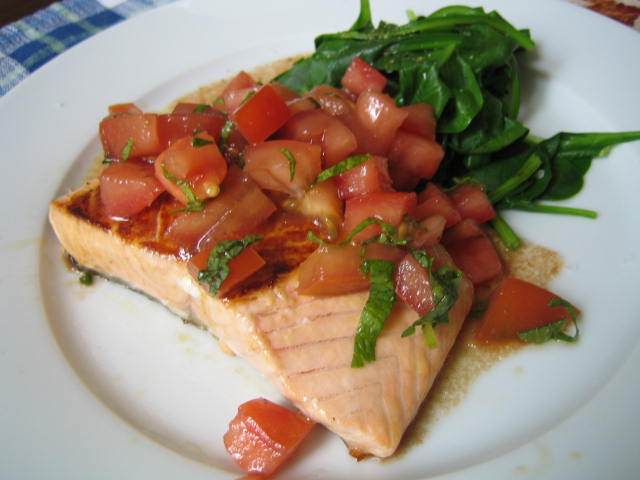
Salmon, Spinach with Tomato and Mint Salsa


it may take me some time to get to the point so, in the meantime, enjoy the end product


I’m finding a curious trend in the books / movies that I’ve encountered of late:
- The life and death of Peter Sellers ~ the biography of a man obsessed with his on screen character to the detriment of his life.
- Supersize Me ~ a month in the life of a guy who forces himself to eat only McDonalds in order to prove a point.
- Round Ireland with a Fridge ~ the story of Tony Hawks travelling around Ireland over the course of a month with only a fridge (and national radio) as a companion.
- The Know it All ~ tracking the author’s attempt to read and digest the encyclopaedia britanica.

These have helped me reach a few conclusions:
- Peter Sellers may be my favourite actor
- Geoffrey Rush may be my favourite actor
- I must watch more Peter Sellers or Geoffrey Rush movies
- I need to explain the thread behind this blog fast …

These 4 books / movies (what's a good term for these .. media?) all of these reveal an odd similarity in their subject; a single-minded determination in the part of the hero to explore a theory or idea at the expense of everything else. It’s all method acting of a kind. Stressful stuff... the blog was in danger of becoming a similarly all consuming affair lately. I've decided to limit myself to a blog per week ~ increase the quality, lower the frequency (don't laugh).

To get away from the deadline stresses of blog writing, I recently went to have my cholesterol read (it’s cheaper than seeing a psychologist and, for me at least, I hoped that it would be more revealing). A week after the reading, upon contacting the doctors’ surgery for the results, Blanca was told that they could not give the results over the phone and wondered if I would come in person.

We went together. I fearing the worst … and Blancs wanting to grab a coffee (sometimes you need support no matter what motives it has). The doctor greeted me with an ominous “Hello Mr. Cooper, please come in and take a seat”. My life flashed before my eyes; all that cheese, all those steaks, why didn’t I just ease off a little. How could I have done this to my body … would I even make it to the seat without collapsing?

My fears were relieved when she followed with “How can I help you today?” Bless the NHS; the cutback in financing of the healthcare in the UK has at least ensured a certain lack of sentiment behind any life altering news that you may be delivered. I assumed that they wouldn’t tell me over the phone on the off chance that the worry and apprehension would cause a heart attack and allow them give my place to someone else in the queue.

The verdict was far more positive than I had anticipated. The result was a “moderately high” reading. Not bad considering that I have a moderately extravagant diet. It was a lower reading than 3 years ago (when I went to visit a similar psychologist). All in all I took it as a vindication and general thumbs up on my lifestyle.

The doctor was completely unwilling to give any creative advice on lowering my cholesterol other than getting it checked every 6 months and considering cutting out butter, salt and mussels. I tried to explain that I was married to a chef, she was Spanish and I had at least one blog reader to think about … but this seemed to fall on deaf ears (or at least hard of hearing, professional ears). It seems that in the UK it is better to die from dietary boredom than heart disease.

For this reason, I have decided to pursue a diet styled upon the great actors and authors of our time. Over the next 6 months (or week), I will become a “method actor” of nutritious diets. I will not sacrifice the salt in my soup, the saturated fat in my steak; but I will look at creative means to boast the chances I have of eating well and, according to some eager sources, adding 10 years to my life.

It turns out that I already eat well (there goes the quick wins). Our post-visit celebration meal serves as an indication of how easy it is to eat your way to health. In writing the analysis below, I have used the fascinating WHF website as source and explanation of various ingredients’ benefits.


Ingredients:
- Salmon fillets
- Mint leaves
- Tomatoes
- Spinach
- Salt & pepper to season
- Olive oil & balsamic vinegar

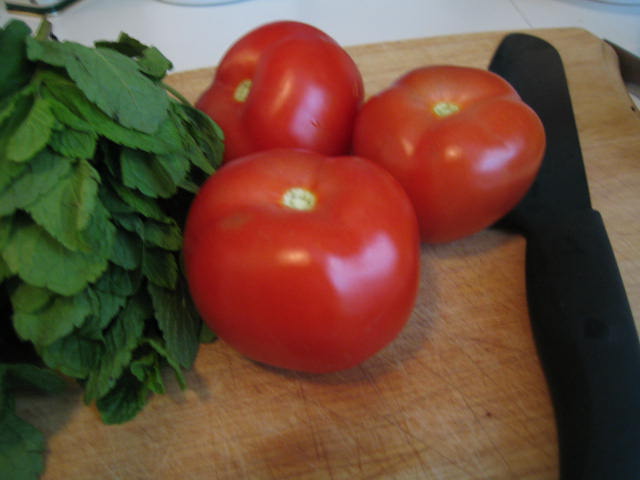
As with the healthiest foods, the instructions are very simple. This also ties in nicely with my abilities as a cook. Starting with the tomato, slice it from the base. Cut the slices both horizontally and vertically in order to cube the fruit. For the mint, a new technique that I learnt (... uh, I've also forgotten the name, but will find out again and update). Roll a few leaves and slice finely in order to produce long cuts of the herb. Mix with olive oil and balsamic vinegar, season with salt and pepper as per your preference.

Fry the salmon in a pan with olive oil. Steam the spinach. For this we used a new steamer that I brought home from Japan, but any steamer will do. Really you are just trying to cook with the vapour in order to keep as many nutrients in the vegetable as possible.

Serve immediately with the salsa on top of the salmon.

So, why so healthy?

Spinach
Harvested in March to May. Apparently, calorie for calorie, spinach provides more nutrients than any other food. It has antioxidants that fight cancer, it builds strong bones, it combats heart disease with vitamin C and magnessium. It also aids eyesight.

Tomato
Slightly out of season, but still juicy. Antioxidants (lycopene) helps protect against oxygen damage and is protective against many types of cancer. What immediately strikes me is that tomato is extremely high (57%) in Vitamin C. This is apparently the most beneficial vitamin for fighting the hardening of veins. Interestingly, scurvy (lack of VC) is thought to produce what is called “leaky arteries”; allowing nutrients to be lost from the blood flow. Cholesterol is actually the bodies attempt to dam these leaks. Therefore, Vitamin C can fight leaky arteries and produce longevity and suppleness in arteries. OK, I’m sold.

Salmon
Here’s the king of healthy eating. Cold water fish are a rich source of Omega 3, an essential fatty acid. This fat is required to keep the body in good working order. It is thought that it actually rectifies imbalances in the balance between the cholesterol types in the body. This theory extends to the reason why the Japanese and Mediterranean diets are (were) so successful for long lives. Omega 3 is something that I am going to continue my research on. It hasn’t been recommended by the doctor or by anyone that I know who has high cholesterol, but various articles and research sources talk about it. I am going to take supplements over the next few months and see the end effect on my cholesterol levels.

That’s all I have at the moment – I’m feeling weak right now. I’m going off to find a tomato eating salmon who has a spot in their schedule for lunch.

Wednesday, April 20, 2005

R is for Mussels

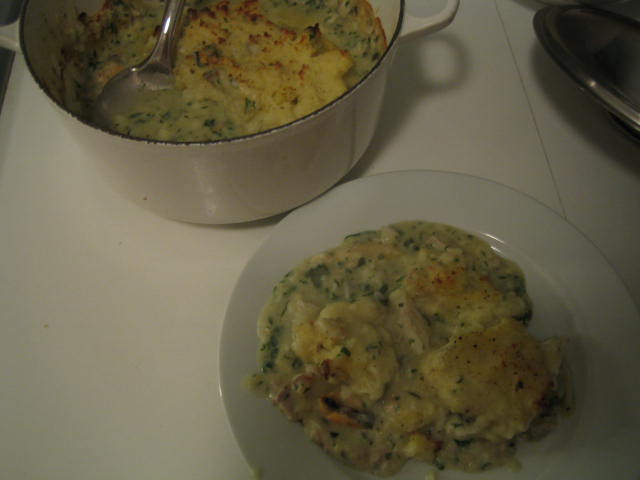
Creamy (distinctly not cholesterol friendly) fish pie

I went for a cholesterol checkup a few days ago. In preparation I was to feast ... sorry, I mean FAST ... for the evening. For a kind of send off, and knowing that this is last month that we can have mussels, we had some delicious fish pie last night.

It's April, so, in theory, the last month to enjoy good mussels until October. This is based on the Month with an R rule. The reason for this old adage is simply that this group of shellfish tend to spawn thereby losing succulence, relatively empty etc. Steingarten, in his great essay, “Hot Dog” mentions that one in every two thousand servings of raw molluscs is likely to cause illness. Limiting consumption to the R months reduces the likelihood of Vibrio Vulnificus infection (exaggerated by warmer water).


I cooked from Nigel Slater's Appetite.

The ingredients (for 4-6) as follows:
-mussels
-smoked haddock
-cod (little addition here – I’d been recommended to use white fish to balance the smoked haddock)
-white wine
-milk (500ml)
-butter (50g)
-plain flour - 4tbsp
-parsley - chopped
-potatoes for mashing
-salt and pepper


The directions are fairly straightforward. Cover the mussels with wine and bring to the boil. Let them steam for one or two minutes until all the mussels are open. It is best to cook them shallow (in a single layer on a shallow pan) in order to pick cooked ones out from the rest. Sieve the wine to collect it and make sure there is no grit in the sauce. Take the mussels from their shells.

Bring the haddock and cod to boil in milk (with as much water needed to cover the fish). Leave to simmer for a few minutes until the fish comes away from the skin easily. Take the saucepan off the heat.

Make the mash (see cottage pie), use some of the haddock liquor to the mash.

Make a roux with the butter (melted) by adding flour and stirring over a moderate heat until it is biscuit coloured and nutty. The addition of the mussel and 500ml of the haddock milk will convert this from a roux to a veloute. Leave to simmer; stirring over 10 minutes to ensure it doesn't stick.

Skin the fish and add to the sauce with the mussels and parsley (chopped). Season this with pepper and salt. Put all of this into a dish and put the mash on top (don't worry if it sinks a little - that's life).

Preheat the oven to 200c and heat until the top is crusty and the sauce bubbling up around the edges. You'll need a spoon to serve!


creamy fish pie and some nice product placement - i wonder when i'll get my first sponsorship deal?

I was a little disappointed just now to read in Leith's techniques bible that crustaceans have very high cholesterol and are best avoided by those with hereditary conditions ... oh well, you can't have everything. From now on I’ll just look for the crustaceans that lead a healthy life and eat those.

Naturally, this will be my excuse if the results come back high.

Monday, April 18, 2005

heating olive oil

Following on from a debate with friends the other night - does anyone know of the impact of heating on olive oil?

Being married to a spaniard, this is something that I would have thought that we had the answer to immediately, but I'm struggling. From looking around the web; olive oil source and tertulia online, it seems as though heating does not negatively affect the nutritional benefits ... but, you never can trust the web ...

Tuesday, April 12, 2005

yakult - the elixir of life?

curious “fever prevention” broth

No visit to Japan would be complete without a blog about yakult. The little drink is as much an icon of the society as noodles, fish and slurping...


Yakult was developed by Dr Minoru Shirota in Kyoto, Japan in the 1930s. It is what is called a probiotic; containing "friendly bacteria" thought to counter the "dangerous bacteria" that can cause disease. There is much debate as to whether the bacteria in probiotic drinks actually survive the digestive system in order to provide any substantial benefit. This is not a time for scientific debate; this is a time to celebrate a cultural oddity...


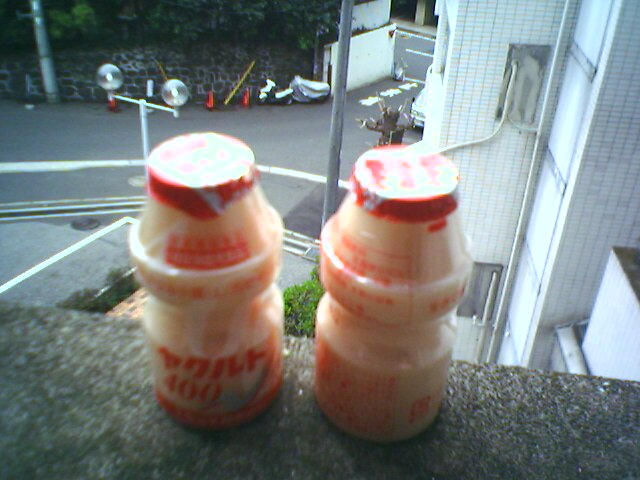
bottles of yakult admire the view whilst on a date

some facts about Yakult:

- the company is called yakult honsha
- Lactobacillus casei strain Shirota is the highly concentrated bacteria found in the drink
- In Japan, yakult costs 370 yen for a 5 pack - approximately £4.92 per litre. In the UK it costs £5.91 per litre.
- they sell approximately 15m of the little bottles 23 countries annually
- Danone owns 19% of the company
- a hong kong paper published an article stating the yakult could help prevent SARS. panic buying ensued (yakult started selling approx. 1m bottles a day in HK and east asia) until the company was forced to announce that, whilst it will "keep you healthy and less prone to getting the virus", there was no studies to support the fact that yakult could actually prevent or cure SARS. note: whiskey and cigarettes were also rumoured to have beneficial effects on SARS
- in 1998 the chairman and vice-president resigned over losses of $800m due to speculative trading
- the company owns an appropriately named baseball team "yakult swallows"
- the brand is hailed by academics as a leading example of education marketing - building awareness through first-hand contact with consumers; sampling, seminars and trademarked packaging
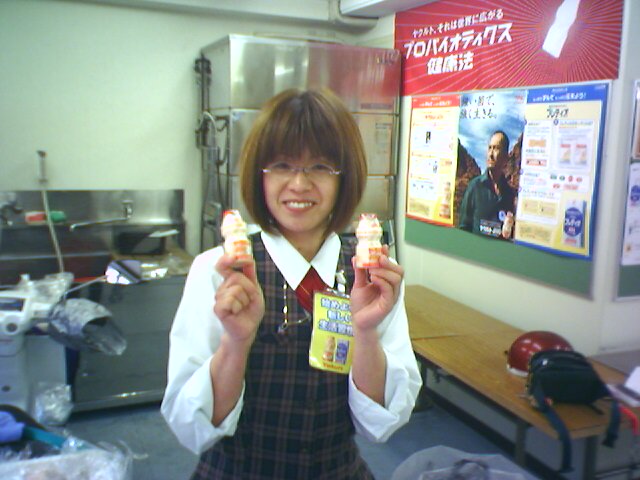
- there is a direct to consumer distribution channel in japan (much like newspapers and milk in the west). this is called the "unique yakult ladies system of door-to-door distribution"


the "unique yakult ladies" work on a commission basis ~ they can earn upto £50k pa; good reason to smile

- yakult has been found to relieve ulcerative colitis, decrease risk of bowel and colon cancers, cut cholsterol levels. A Swedish study connected it to reduced risk of asthma and allergies in babies... they may also help elderly people as the levels of good bacteria decline with age...

- many western scientists call yakult a "novel food"; being unsupported by clinical trials. whatever about the longterm benefits, there is general agreement that yakult induces bowel movement... hmm.

recipe for "fever prevention":
to try and keep somewhat the food blog theme; yakult recommend a natural prevention for colds and fevers:

- 1 drop lemon juice
- 1 drop eucalyptus oil
- 1 drop tea tree oil
- yakult
- hot water

mix in a bowl. place a towel over your head and inhale the vapours... good luck.

visiting kyoto with mr. steingarten - day one

In his book "the man who ate everything" jeffrey steingarten brilliantly recounts his visit to and awe of kyoto cuisine. I read this on my last flight from tokyo and vowed to myself that i would go to Kyoto and retrace his steps; a culinary pilgrimage. My preparation for the trip involved photocopying the chapter. We neglected to read any guidebooks, this was going to be a spiritual journey to the spiritual heart of Japan.

Taro and myself started out on friday at midnight with a night coach from shinjuku, tokyo. Mr. steingarten arrived at kyoto on a luxury cruise ship after travelling around the southern half of japan. I should point out that this was going to be a budget remake of his trip. The night bus was quite a curious thing; similar to lying in a coffin on top of a speeding flying carpet. "Fitful" best describes the night's sleep; "relieved" best describes my mood on arrival.

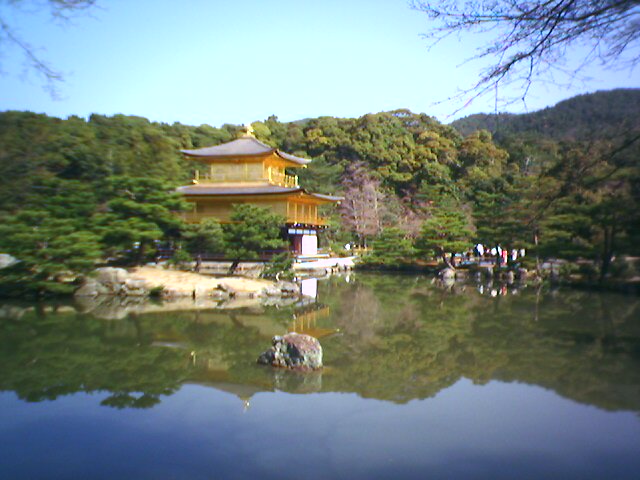
Kyoto was japan's capital city for just under 1100 years. It is still the emotional capital of the country and home to many temples. We arrived at 7am. Knowing that it would be height of glutony for us to start eating immediately, we got the bus to the golden pavilion (Kinkajuji). This is a UNESCO world heritage site with a garden that remains as it did hundreds of years ago. I don't want to appear unimpressed by the temples of Kyoto, they are truly magnificent. My personal view is that I would rather get away from the crowds of tourists, the flash of the camera and experience the real life of the city ~ I'll leave it at that.


the pond is called kyoko-chi (mirror pond) ... i wonder why


Now that we had done the "intellectual" part of the trip, we decided to get onto the subject of our visit... la comida...
An unexpected hanami party on the philosopher's walk led us to the ginkakuji temple. Somewhat controversially we performed a deft left turn and (in order to see the view and build our appetite) climbed the Higashiyama Mountain. We arrived to the top sweating and gasping with heart palpitations. It was quite a humbling experience to find about 100 pensioners who apparently had made the trip earlier, faster and with picnics (no wonder Japan has the longest life expectancy of any country in the world). There was only one thing for this ... revenge through eating...


We went to Kawaramachi, the main food and shopping district for okonomiyaki. This is in fact an Osakan specialty, but as we were only half an hour away we didn't feel much remorse. Okonomiyaki is a thick savoury pancake that contains shredded cabbage and diced seafood or meat. It is most often topped with tonkatsu sauce, mayonnaise / mustard, tempura crumbs, green onions and bonito flakes. It is cooked much like Teppenyaki, on a grill in front of the diner. The food is then moved to the cooler, diner side, of the grill to be eaten. It is not exactly healthy, but is really delicious after a climb. It calms bruised egos.


As you can probably tell, the whole weekend hadn't exactly been planned up to this point. Having had our first meal, we were at a cross roads, a moment that would most likely shape the remainder of the weekend and perhaps my memories of this part of Japan. We had two options - get a hotel in Kyoto or go to Osaka to meet Jumpei, an old friend of Taro's. Given that we had no hotel booking and that all seemed to be full, we decided that we really did want to head to Osaka.

Osaka is Japan's second most important city and the third largest. If that doesn't give you enough of summary, you can find the city's fy2005 budget proposal here. After only one night there I can say that its population of 2.5m are nearly all mad! This was a ... varied night; I'm going to give you the edited highlights.

JS mentions the ongoing debate as to whether Osaka or Kyoto have the best cuisine in Japan. I'd have to go with Osaka in this debate (mostly because the great cuisine of Kyoto; kaiseki ryori was somewhat too expensive for this weekend). Jumpei explained to us over dinner that the Osakan philosophy of food is ruled by a continuous quest for improvement. They are passionate about food. The local word "Kuidaore" probably best describes this; "to eat oneself bankrupt".

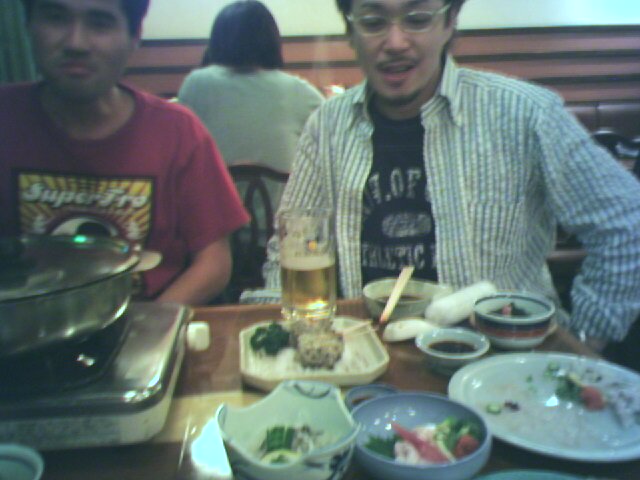
The other thing that you may do in Osaka is "eat yourself dead". As we all know, the best way to do this is with blowfish. For this reason (and to my eternal surprise) we went to a blowfish restaurant. Before you think this was crazy, my arm was twisted by Taro and Jumpei saying that more blowfish is eaten in Osaka than anywhere else in Japan. They insisted that the death "rumour" is vastly overblown (hah) and, more importantly, the fish is extremely good. The liver is the dangerous part of the fish; chefs will train for years to prepare the food. I was going to post instructions on how to cut it, but i don't want to be sued. I will mention that the kanji for blowfish is 河豚 (river-pig; obviously because a: it's not a pig and b: it comes from the sea) ...


would you trust either of these two? i can't believe i did ...


My first bite was the most difficult, but thereafter this was an incredible meal. The meat is actually quite delicate and when cooked reveals a surprisingly chickeny flavour. You are supposed to get a tingling sensation, especially on the lips, but I have to be honest and say that I didn't. The beer did give me a drunken sensation.

We ate a very traditional meal including:
Fugu skin - blanched in boiling water and eaten with ponzu sauce (soy sauce and citrus juice)
Fugu-sashi - thinly sliced raw fugu, basically sashimi
Fugu-chiri - similar to a chanko-nabe; vegetables and fugu cooked in dashi soup in a large pot
Fugu Kara-age - floured and deep fried
Fugu testicles - unsurprisingly soft and, my dignity would say, not the tastiest part of the meal

Investigations on the web have since revealed:
- there are 100 deaths a year caused by blowfish; this has been contradicted by another source quoting only one death
- blowfish is the only delicacy that is not permitted to be served to the emperor
- tip from lonely planet "make sure the local emergency number is plugged into your mobile. Given that mine doesn't work in Japan I didn't feel so aggrieved about not obeying this recommendation
- it is the only species of fish that can close its eyes

Given that I had lived through the experience, we went out to celebrate for the evening. This culminated with checking into a capsule hotel at 5am ... Mr. S never told me about this.

Next on zarzamora - getting out of Osaka alive, getting sidetracked by more food and a visit to THE food market.