Tuesday, October 11, 2005

It's a small world afterall...

What are the chances? To be sitting in Andalucía watching a cookery / travel program... the narrator is talking about noodles. In a city of 12 million people, they happen to go into Akasaka Ramen. A ramen store opposite my old work that we would go to frequently.

akasaka ramen
It's a small world afterall....

Respect to:
Canal Viajar
Akasaka Ramen... a good noodle restaurant.

Friday, October 07, 2005

In Season in Spain

Well, it's been a long time. Just over a month. I feel like I'm talking to an old friend that I haven't seen since school. Either way, I'm back on the blog. It's going to be a little intermittent over the next while, we have made the move to Spain, but are still waiting the arrival of our the rest of our flat from London. I managed to forget our camera so this is going to be a pictureless blog.

For this blog, I thought I'd do some Spanish homework at the same time as researching a little bit about the food in season at the moment. The following list is from Simone Ortega's very good "1080 Recetas de Cocina". They are all the ingredients in season at the moment. I have asterisked those that I needed the dictionary to translate...

Verduras (vegetables)

Champiñon de París = button mushrooms
Acelgas = chard or beet*
Zanahorías = carrot
Puerros = leek
Lechuga = lettuce
Cebollas = onion
Cebillitas francesas = shallot*
Remolacha = beetroot*
Coliflor = cauliflower
Espinacas = spinach
Lombarda = red cabbage (based on google image search only)*
Repollo = cabbage*
Apio = celery
Tomates = tomatoes
Pimientos verdes y rojos = red and green peppers
Alcachofas = artichoke
Calabacines = courgette
Berenjenas = aubergine
Judías verdes = green beans
Calabaza = pumpkin ... or "to fail"*

14 of 20 without using the dictionary

Pescado y mariscos = fish and shellfish

Merluza = hake*
Pescadilla = whiting*
Rape = monkfish
Lubina = sea bass
Lenguado = sole
Gallo = rooster* (eh, not really a fish?)
Breca = sea bream? courtesy of www.fishbase.org via google images Pagellus erythrinus*
Rodaballo = turbot or flounder*
Congrio = conger eel*
Sardinas = sardines
Boquerones = anchovies*
Besugo = sea bream*
Pez espada = sword fish
Calamares = squid
Cigales = crayfish (dublin bay prawn)
Gambas = shrimp
Chirlas = something like baby clams, may not have an English name?*
Langosta = lobster
Langostinos = languistine
Bogavante = hake*
Carabineros = a little crustacean, this is a somewhat vague translation from blancs*
Almejas = clams
Mejillones = mussels
Ostras = oysters

13 of 24 without the use of dictionary*

Frutas = fruit

Piña = pineapple
Manzanas = apples
Peras amarillas = yellow pears
Peras de agua = water pears
Limones = lemons
Naranjas = oranges
Pomelos = a pomelo?*
Melón = melon
Uvas = grapes
Ciruelas = plums
Chirimoyas = chirimoya*
Plátanos = bananas
Membrillos (desde medio mes) = quince (from the middle of the month)
Aquacates = avocado
Kiwis = kiwis

13 out of 15 without using dictionary. Both pomelos and chirimoyas are new to me, but I have eaten both previously... if you know what I mean.

Carnes = meat

Pollo = chicken
Gallina = hen
Conejo = rabbit
Vaca = cow
Ternera = veal*
Cerdo = pig
Cordero = lamb
Mollejas de ternera = fried sweetbreads*
Cochinillo = suckling pig
Perdices = partridges*
Liebre = hare*
Codornices = quail*
Becada = a game bird, but I don't know what the English name is
Faisán = pheasant
Aves acuáticas = aquatic birds?
Venado = veniso*
Jabalí = wild boar*

8 of 17 without dictionary

A few things that the above tells us:
- I understand about 63% of the food in Spain. That makes me a C student, I reckon that is about right.
- I have learnt more fruit and vegetable names over the past years of coming to Spain (87% and 70% respectively). This could either point towards their strong role in the mediterranean diet or, maybe you shouldn't trust my translations.
- Meat and fish let me down (47% and 54% respectively). Alan Davidson would be disappointed. I guess any low cholesterol diet would have mixed feelings on it...

Either way, you can expect the above to feature heavily in recipes over the next month... I'm now going out for something that I can understand; tinto de verano y tapas.

Technorati Tags:

Monday, September 05, 2005

Gone West... Looking for Gold

Dogs are at the kennels, cat has gone missing, the children off to the local chimney sweep to work... we're off for a week's holiday on the east coast.

We've got the essentials:

book stack1. Coleman Andrews, "Everything on the Table"; Blancs has told me he is one of the best food writers. She reckons I can learn a thing or two from him (I take the subtle hints where I find them..)
2. Notepad for thoughts, poetry, my memoirs etc.
3. Books for Cooks recipes in case we get caught out and need to fend for ourselves
4. James Villas, "Villas at Table" - this one is for Blancs
5. Superdrug's Omega 3 supplement to fight the burgers and large portions that we'll be consuming

Not sure if this is a present or emergency rations for the BA flight:
A Marks & Spencer's hamper;
1. Tea
2. Toffee
3. Shortbread
4. Mustard
5. Pickle
6. Odd looking rhubarb & custard sweets

Friday, September 02, 2005

The Kitchen's Least Wanted

Unreasonable taste, texture and blandness


Known Aliases: Pasta, Shaped Pasta, Orecchiette, Small ear pasta, Puglian pasta

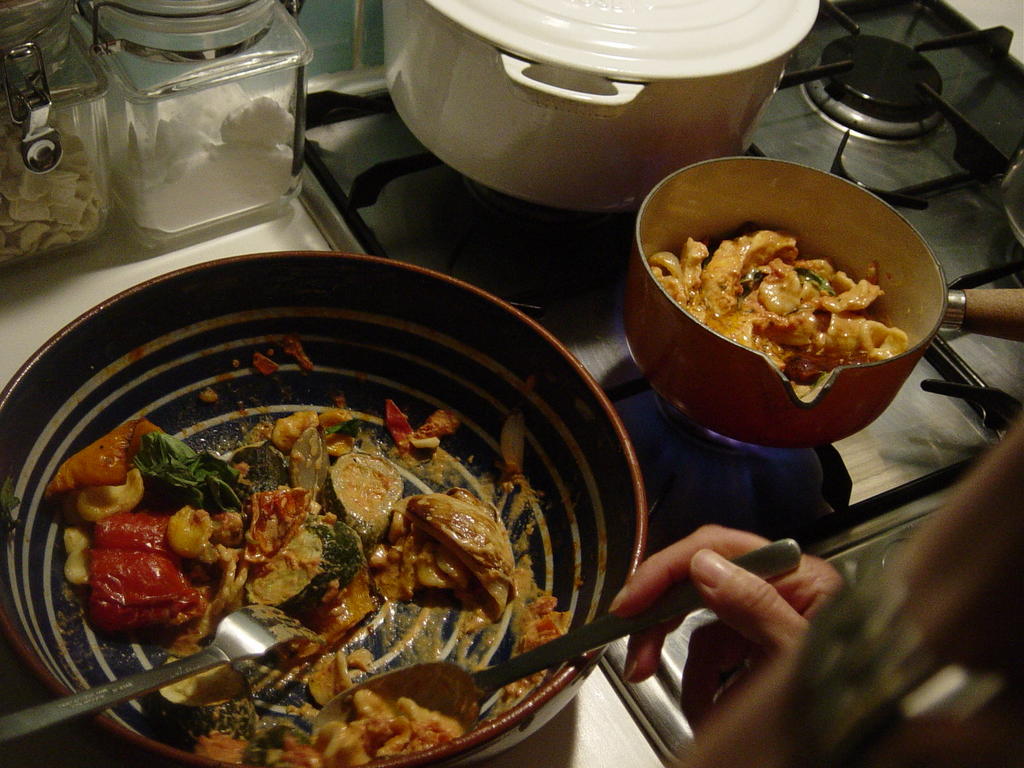
Photograph taken on 1st September 2005, 23:14 BST

One of Orecchiette's common disguises; being cooked with vegetables and chile sauce

Description

Width: approx. 3/4 inch across
Unusual markings: slightly domed, their centers are slightly thinner than their rims
Texture: soft in the middle, chewy on the outside
Cooking time: up to 20 minutes
Disguises: can plump to twice its size when cooked

Caution

Orecchiette is currently no longer wanted in our kitchen. It was cooked this evening to go with some vegetables that we needed to finish. The lives of these fine vegetables (shallots, peppers, tomatoes, courgettes) were lost in the fight against this menace of a pasta.

Considered vile and extremely bland. Do not cook under any circumstances

Thursday, September 01, 2005

Was it Mr. Mirepoix in the Kitchen with the Soup?

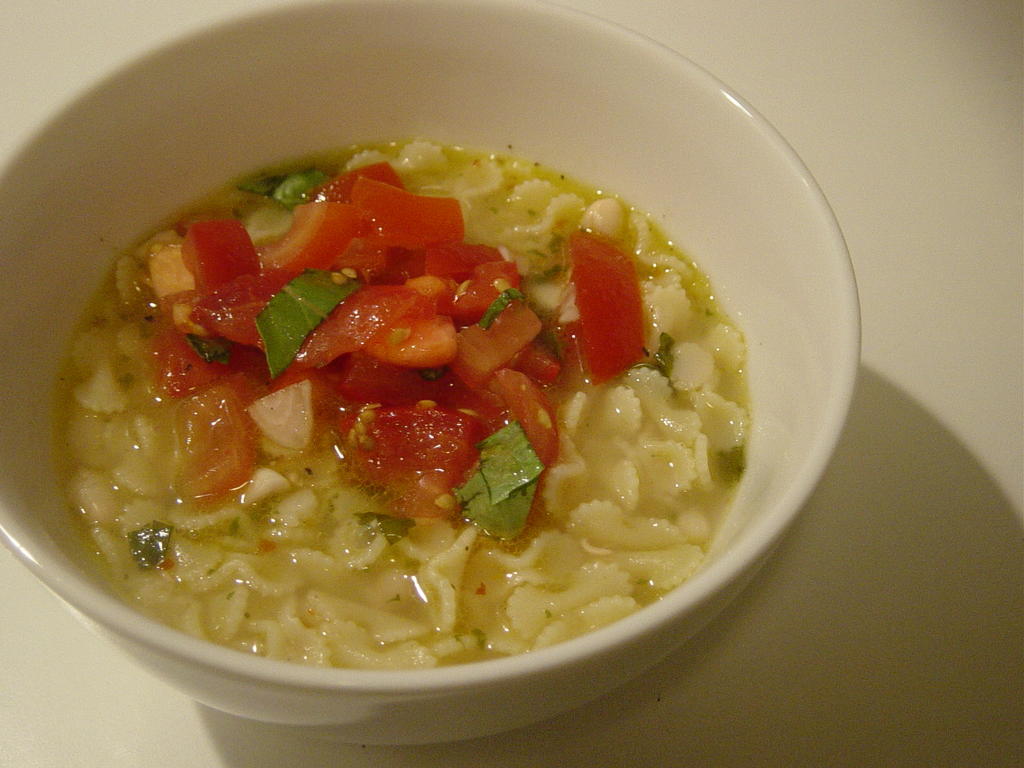
Catwalk title: “Summer White Bean Soup with Fresh Tomato Salsa”
Steve’s title: “Spicy pasta soup”

is it a soup or is it a pasta?
I may have reached some kind of milestone with all of this cooking. Last night, I prepared a soup from the Books for Cooks back catalogue; myself and Blancs were equally disappointed. OK, whilst this may sound like somewhat of an anticlimactic milestone, the fact that we both agreed on what was lacking is an improvement in itself…

Here’s the recipe… check it out, for theory if not for practice:

Ingredients salsa (for 4)
4 ripe tomatoes, diced
¼ red onion, finely chopped
1 tbsp olive oil
A handful of basil leaves, cut into strips
Salt, black pepper

Soup
4 tbsp olive oil
2 garlic cloves, chopped
½ tsp crushed chilli flakes
125 g cannelloni or haricot beans (soaked overnight and simmered until tender (1 – 1 ½ hours)
90 g small pasta
Salt, black pepper
Grated parmesan to serve

For the salsa, dice the tomatoes (cubes), mix with the onion, olive oil and 1 tbsp of basil leaves. Season as required.

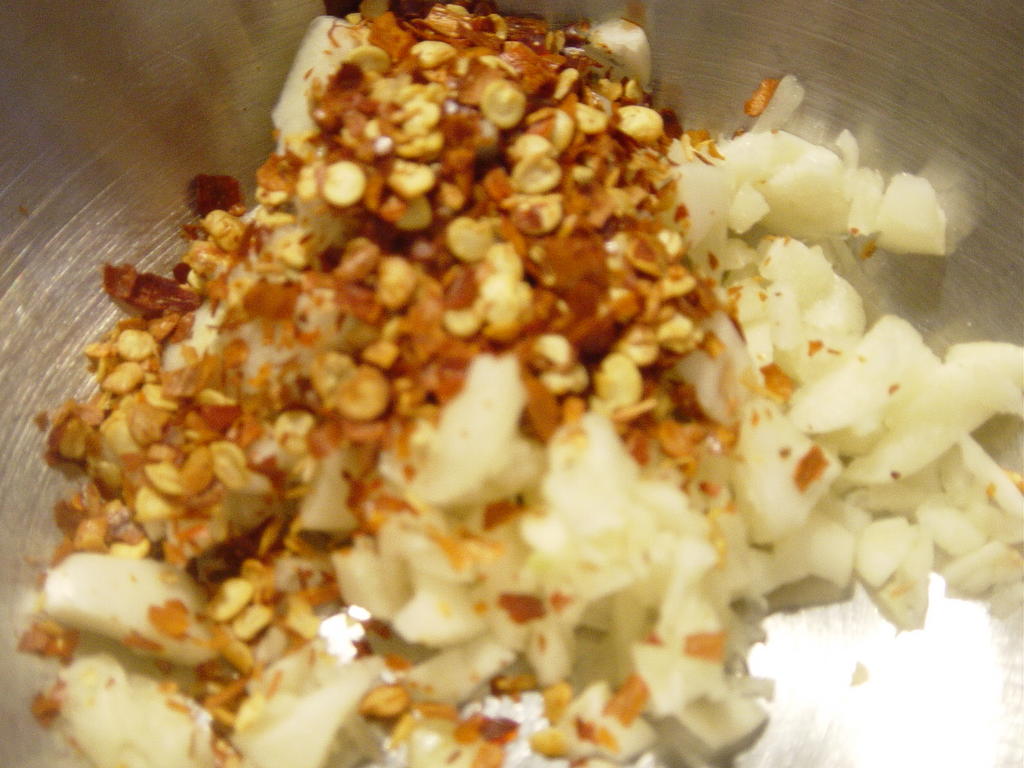
garlic and chile flakes
For the soup, heat the oil and add the garlic, chile and remaining basil. You want to release the flavour. To be honest, I didn’t get a big release of flavour, but the instructions recommended 1 minute. I guess just make sure that you don’t brown the garlic so use a low to medium heat.

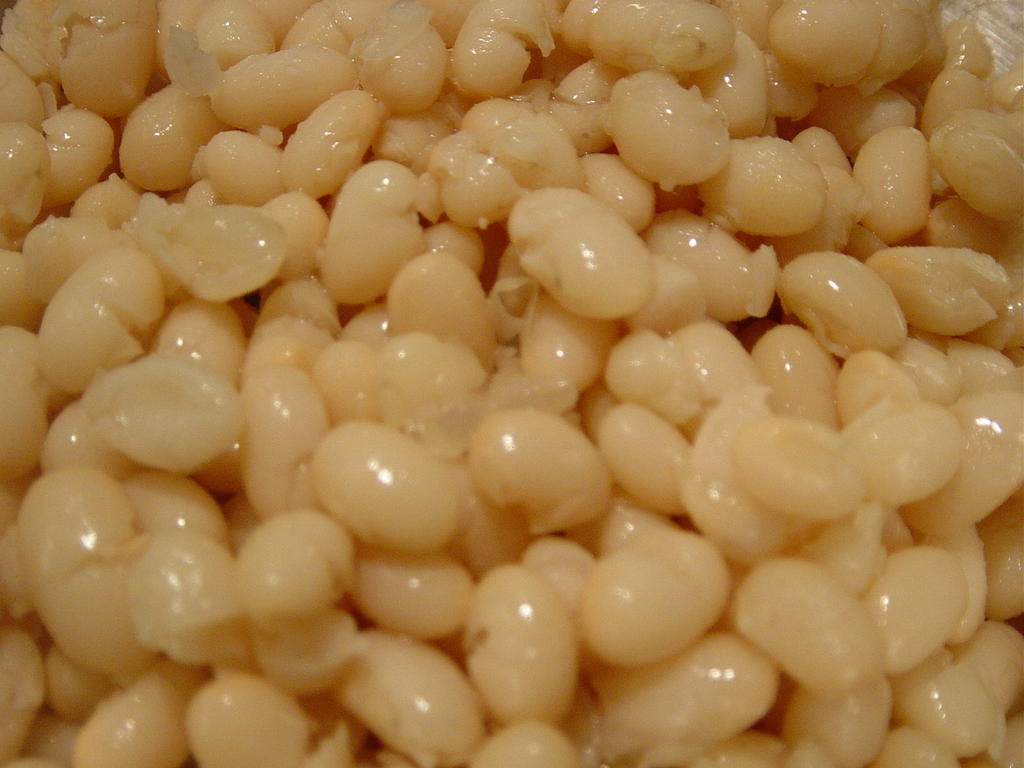
beans, beans and more beans
Pour in the stock and beans. Bring to the boil and simmer for 15 minutes. Take out one cupful of beans and liquid and blend until smooth. Add the pasta to the soup and simmer until al dente. I was given a tip recently from Victor a chef at the ElBulli Hotel… bite a single piece of pasta in order to see if it is cooked. The core starch (similar to rice) should have just about vanished.

The recipe recommends serving this as a hot or cold soup. I served it hot.

So, what went wrong? I was eating the soup thinking that there was something missing; texture and flavour. I went along the lines of:
- too much pasta
- too little bean texture
- too bland a flavour; garlic was the predominant flavour

Blancs and I were on the way back from the local this evening and discussed the soup… happily we were both in agreement on the problems. Some solutions recommended:
- use less pasta. It obviously swells up a lot and runs the risk of overwhelming the other somewhat neutral ingredients. I would try maybe 60 g next time.
- use more beans. As the recipe says, this isn’t just a case of not blending the beans… that is needed in order to give body to the soup. I think that you’d need to nearly double the quantity; 200 g?
- regarding the flavour, here was where Blanca revealed some culinary artistry to me… mirepoix.

A chance to research a "classical French cooking technique"... I couldn't resist it. No sooner had I picked up my pen and paper and was approaching the bookshelf, than Blanca suggested that I should blog about some of the books that I reference. I like it... a reference about reference books... circular... a coffee table book that's about coffee table books... you've got to like her style.

I’m still reading my way through the books so couldn’t pretend that I have developed anything but a passing relationship, but here is what I have so far (in order of preference):

1. Harold McGee, “on Food & Cooking“. Any regular reader will know how much I reference McGee... he's gonna chase me for royalties soon. The master of food science, I only respect people with a deep and unfailing love for McGee. He is the only author that manages to cover any topic that I’ve researched.
2. Spaull and Bruce-Gardyne, “Leith’s Techniques Bible”. Great. Blancs is a Cordon Bleu girl so hates the bible (eh, she's Spanish, so not that Bible, the other bible), nevertheless, it’s good for all of the techniques that I don’t understand.
3. Rombauer, Rombauer Becker and Becker, “Joy of Cooking”. Old hat in the US, but still ignored in many parts of Europe. The joy of cooking is the most comprehensive reference and recipe book. It also manages to blend the two very well. My first memory of the Joy of Cooking was seeing it in Blanca's flat in Brussels and getting excited when I thought it was the Joy of Sex... not sure which we would have gotten more use from.
4. Various, “Larousse Gastronomique”. New in (see below) at number 4 and with good potential to move up the charts in the next few weeks.
5. Shirley O. Corriher, “Cookwise” There is something that I don’t like about Cookwise. It falls between the cracks of reference book / recipe book…
6. Stephanie Alexander, “The Cook’s Companion” Not available on amazon.com... I don’t get it (mentally rather than physically). It is really well written, but sorted by ingredient and doesn’t successfully bridge reference and recipes; rarely consulted.

A little bit about Mirepoix

The “Joy of Cooking”, not usually the most poetic of books, evocatively describes the purpose of mirepoix…

“many sauce recipes begin by sautéing a mix of aromatic vegetables… cooking these first in a bit of butter, olive oil, or other fat releases their flavo[u]rs so that as you add other ingredients… the entire sauce becomes infused with the character of the flavour base”… “This universal cooking technique forms the foundation for dishes all across the globe... The French have mirepoix - onions, carrots, and celery cooked gently in butter to bring out their inherent sweetness (a white mirepoix for light-coloured dishes substitutes the white part of leeks for the carrots)”

Well, I can’t really say much more…

Some of the versions are interesting. For example, the Italians sofritto substitutes olive oil for butter (I guess I’m a closet sofritto fan); it can also include fennel, leeks, garlic or chopped herbs such as parsley.

From checking out McGee, it seems to be that celery and fennel are both part of the carrot family. Being stalks rather than roots such as carrot. Leek and onions being both onions (allium). He goes onto say that the Spanish version is called Sofregit.

Until today, the Larousse Gastronomique has only served as a useful stand for my stereo. I must indeed have crossed a significant milestone as Blanca felt it was appropriate to finally include it in my reference material. The LC (as I fondly call it) calls mirepoix a mixture of diced vegetables (carrot, onion and celery). It can be used to enhance the flavour of meat, game and fish, in the preparation of sauces, soups and as a garnish for certain dishes. It is said to have been created in the 18th Century by the chef of the Duc de Levis-Mirepoix in France (ambassador of Louis XV... great grandson to Louis XIV who, according to Dumas, was the brother of the Man in the Iron Mask). OK, too much French for the moment...

The traditional ratio is 2:1:1 onion, celery and carrots. This can of course be varied according to recipe, dish, mathematical ability etc.

----- STOP THE PRESS -----

Blanca has just taken the piss out of McGee and The Joy of Cooking:
- Mirepoix is NOT sofritto. “Mirepoix” can refer to the raw or cooked versions. Sofritto is cooked down vegetables, not just aromatics… it can include, for example, tomatoes
- McGee says that the Spanish version of mierpoix is sofregit… apparently this is Catalan… but I reckon that Blanca is just being anti-nationalist.

I guess that I’m back to square one with my reference book guide… don’t believe anything you read! Or else, Cordon Bleu has put the fear of God into Blanca and she is not willing to discredit the French…

Technorati Tags:

Monday, August 22, 2005

Sopa de Tortilla

Sopa de Tortilla


If our tomato and ginger soup could be termed a “classical European soup” (classical being the standard prefix for European food), there is perhaps no better contrast than this spicy tortilla soup from Mexico (spicy being the standard prefix for Mexican food). This is a rough and ready soup; a sieve would get the crap kicked out of it if it came within a ladle’s reach from the pot. I first had it about 5 years ago; it has been a hit with everyone that we’ve made it for, even those guests that protest “I don’t like too much spice in my food…”

Ingredients for 6
1 tbsp corn oil
1 medium onion, chopped
2 cloves of garlic, chopped
4 ripe vine tomatoes, chopped
1 dried ancho chilli, de-seeded
2 ¼ pints stock
30 corn tortilla chips (real tortillas, fried, or bought chips)
2 avocados, peeled, pitted and sliced
110 g feta cheese
110 g crème fraiche
½ bunch coriander, chopped
4 limes, halved

As it is with the best traditional Mexican recipes, you can never find good versions in books. This recipe comes from Blanca's friend Sofia Craxton. It is her family recipe. She has just published "The Mexican Mama's Kitchen"... from a marketing point of view I guess I should strike my previous comment.

Ancho chilli (“wide”) is a broad, flat, heart-shaped dried pod of the poblano chilli (“of the village” and of Puebla in Mexico). These are relatively mild (1,000 to 1,500 Scoville Units or 3 on the Heat Scale). The chilli can be sold fresh, often stuffed with meats and cheese (chilli relleno) or dried for food colouring or sauces, in particular moles.[1]

Soak the chilli in 150 ml pint boiling water for 5 minutes (until soft). Add the soaking water to the stock. Chop the chilli.

Heat the oil in a pan; add the onion, then garlic, chopped tomatoes and chilli. Saute for 5 minutes. Add 2 tbsp of stock; blend all the ingredients. Return to the pan, add the remainder of the stock and simmer for about 20 minutes. Add the chips and simmer until soft. Serve with avocado, feta cheese, crème fraiche, coriander and a squeeze of lime. Add a half of lime to each bowl.

One issue I had with this soup was the amount of cooking and degradation of the nutritional value of the tomatoes. From consulting Cookwise, I was pleasantly surprised to learn that tomatoes degrade very little during cooking. For baking, boiling and stewing 0% of minerals are lost and only 5% of vitamins.

Sources:
[1] Dave DeWitt and Nancy Gerlach “The whole chile pepper book”

Technorati Tags:

Thursday, August 18, 2005

Todo sobre su espuma (all about his foam)...

Spanish Tortilla… deconstructed


The intermediate term in the kitchen has started with a bang! Blancs and I have been playing around with some of Ferran Adría’s cooking books lately. I think that this is either Blanca’s way of improving my Spanish or scaring me out of the kitchen. Given that she did a stage before at El Bulli Hotel she has a bit of an advantage, but I have sheer bald-faced stupidity on my side.

When dealing with such a superstar chef, where better to start than with one of his iconic dishes. Ferran has made his name as the king of all things "unusual" in the kitchen. He is credited with bringing the foam (espuma) into the commercial kitchens. Methinks with an ironic style, his books attempt to bring the foams into domestic kitchens. Whilst Blancs prefers his classic (and very much out of print) “Concinar en 10 Minutos”, we cooked from “El Bulli: 1998 – 2002”. This is the dark hardcover book that you will find in good bookstores.

There are a few things to understand before we get into the recipe.

What is deconstruction?
In what I believe to be his best book; “Los Secretos de El Bulli”, Ferran explains the prior to 1993, 3 techniques were used to create meals: adaptation, association and inspiration. After 1993 he focused on deconstruction. Basically, it ”uses (and respects) the harmonies already known, transforming the textures of the ingredients, such as form and temperature”. It should retain the ingredients and flavours, but change the textures. Typically, the name of the dishes will remain the same.

What’s an example of deconstruction?
Well, we’re about to look at an example of deconstruction. Everyone knows the classic Spanish omelette; eggs added to olive oil fried potatoes and onion and served upside down. Ferran puts a spin on this, he foams potato mash and layers this over onion and a sabayon of egg yolks.

What’s the deal with foams?
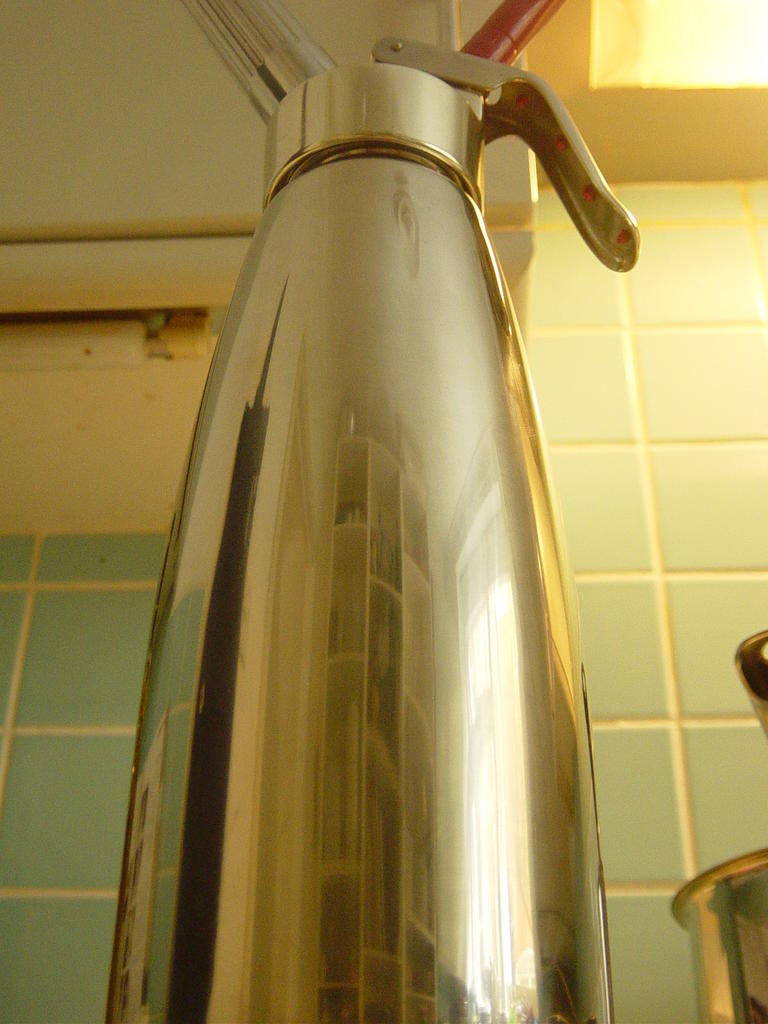
Foams is one of the techniques that allows Ferran produce different textures and techniques. It is an extension of the mousse, with the basic difference that cream and eggs are not necessarily required. Ferran appears to have shares in iSi; he takes every opportunity to recommend their siphon to achieve a pure flavour of foam. He lists the benefits of foams as follows:
- More flavour. As mentioned above, with less lactic products and eggs, the foams hold only the main ingredient flavour.
- Better health value. All fruit or vegetable vitamins and proteins are served intact. There are no additional fats.
- Lighter. The pressured incorporation of air (nitrous oxide) produces a lighter end product.
- Better conservation. The siphon is hermetically sealed and thus preserves food better.
- More economic. Eh, this is kind of questionable. Ok you don’t need extra eggs and cream, but you do need to buy a fairly pricey siphon and gas refills.
- More creative. Also questionable, but undoubtedly, the foam is somewhat more flexible than traditional mousses.
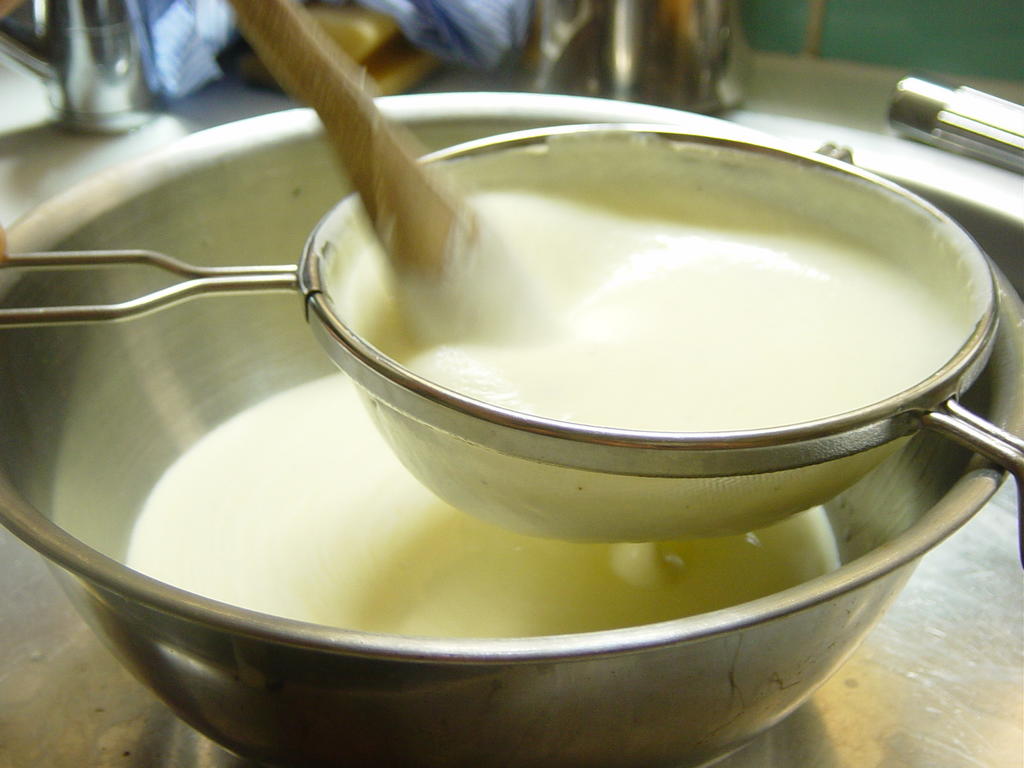
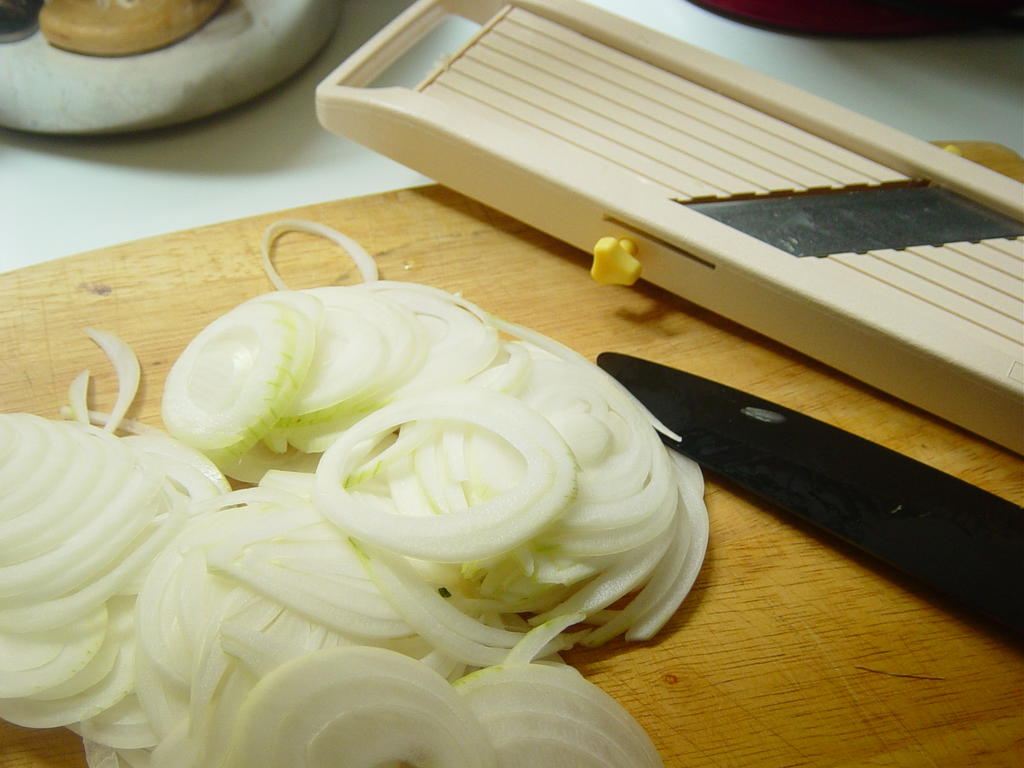
Ingredients for Potato Foam(including mistakes… for 1 very relieved person)
1 iSi siphon
250 g potato
100 ml water from boiled potatoes
3 tbsp olive oil
100 ml cream
Salt

Bring the potatoes to the boil and simmer until cooked. Decant 100 ml of the boiling water before discarding the remainder. Briefly mash the potatoes. Put all the ingredients into a container for blending. Blend until creamy. Season according to taste (we also added pepper).


Sieve in order to remove any lumps that could block the siphon. Be careful here not to press too hard.

Pour the sieved mash into the siphon while still hot. Charge the siphon with nitrous oxide gas. Upturn once or twice after charging. We actually used 3 charges of gas, but, depending on the age, you should get away with 2.

Place the siphon in a bain marie at a similar temperature until ready to use.

Ingredients for Onion and Sabayon
2 medium onions
2 egg yolks
1 black truffle
Olive oil


Cut the onions as fine as possible. I used a mandolin for the first time; definitely worthwhile.


Put into an olive oil pan over a low heat and cook until well golden. Note: you can add water / salt in order to prolong the cooking without drying out the onions too much.


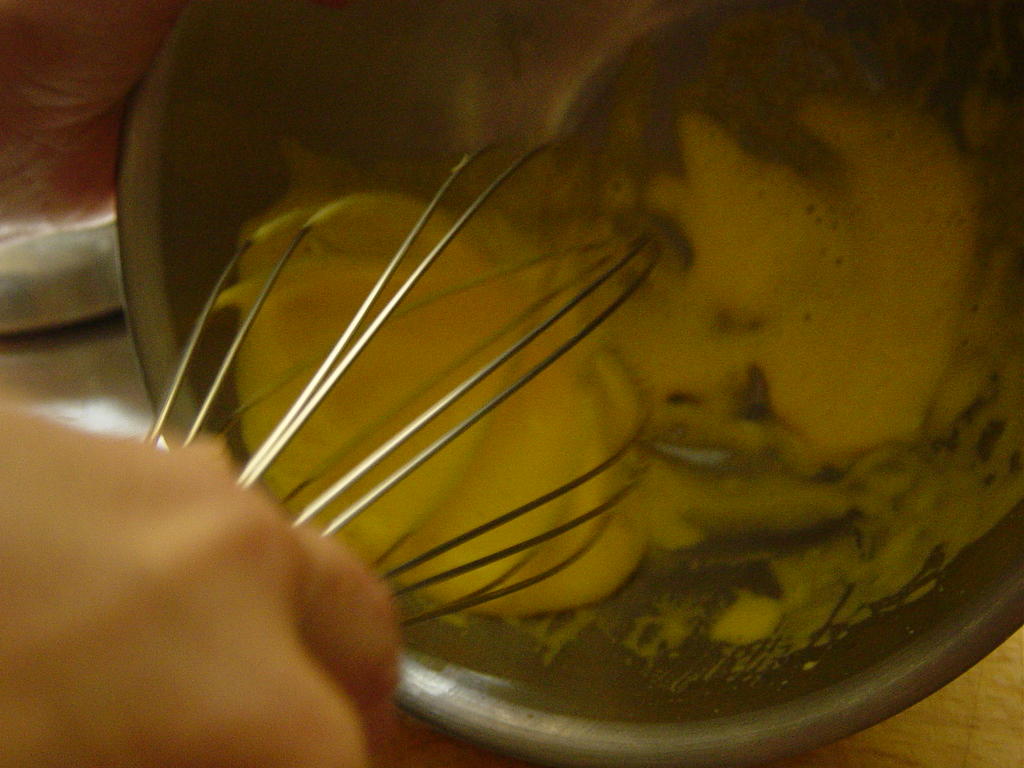
Create an emulsion of egg yolk by adding 2 tbsp of warm water and beating until it holds small channels for a short period of time.

To serve
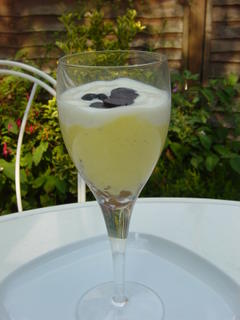
Cocktail glasses are best, but I discovered that all of ours are broken. Wine glasses are best. Put a little of the onion at the bottom of the glass. Put the sabayon on top. Gently apply the foam. This was tricky; it relies on the sabayon being firm enough and the foam being light enough. It is best to hold the nozzle vertical and release the foam until it is at an appropriate level. Top with finely sliced truffle.

The verdict… I’ve had a yoghurt foam before and that was incredible. I wasn’t astounded by the tortilla, but it definitely was different. It lacked a little flavour and I probably used an olive oil that was too cheap (the taste was quite strong). Either way, definitely worthwhile and something that I will try and do a variation on in the future.

I’m thinking deconstructed Irish Stew…

Technorati Tags:

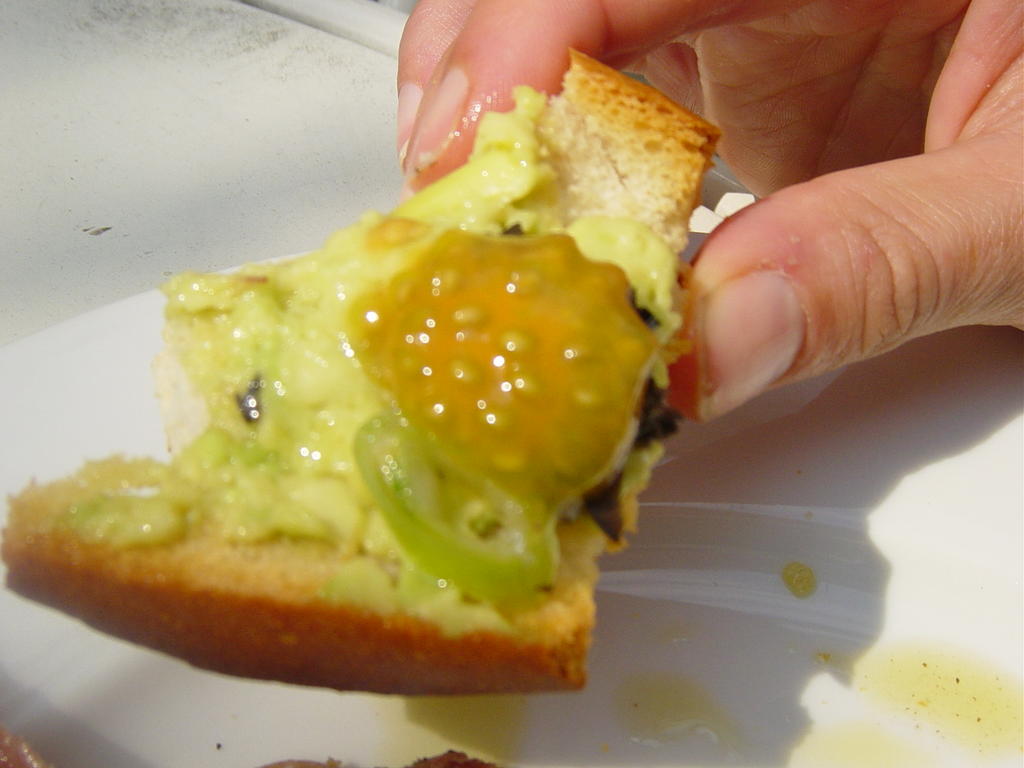
Unusual Food Photos: Name the Fruit


I'll be blogging the recipe later.

Wednesday, August 17, 2005

Logistically Challenged and Misunderstood: Our Modern Day Tomato Soup

Tomato and Ginger Soup

tomato and ginger soup
I came into some flak recently for suggesting that I didn’t like one of the soups that we had cooked. How could I have been so naïve as to criticise a dish while Blanca still had a knife in her hand? In order to avoid A&E we decided to, as with all great workmen, blame our tools. We looked at the pale, tough tomatoes that had just gone into our soup with and found our scapegoat.

Ripeness… what’s a guy gotta do these days? Short of growing and picking your own tomatoes, how can you get good fruit?

Ever since reading Jeffrey Steingarten’s “The man who ate everything”. I have been more aware (and more disappointed) by the ripeness of fruit in our supermarkets. The trend that we are all familiar with is that the ever successful supermarkets claim that the consumers are driving more diverse product ranges. As a result, the wholesaler to retailer distribution channel has to cope with greater distances. Greater centralisation and consolidation of stores results in greater quantity being pushed through these already tired channels. All of this has driven the requirement to pick more robust, durable fruit in order to survive the trip to the store. Unfortunately, durability is seldom analogous with fruit flavour.

Fruits live to ripen, this is what guarantees future generations. If fruits had their own reality show, all they would do is sit in the sun and wait for reproduction (eh, they may have their own show already). The process generally takes place during maturity and decline. Typical changes include colour, taste, aroma, size, weight, texture and nutritional content. Change in taste is what we're interested in here. The process entails the conversion of starch into sugar (sweeter and more desirable). Unfortunately, many fruits convert the starch from the plant (i.e. they don't have starch stores) and therefore will not get any sweeter once they are picked.[I]

The tricky part is that not all fruits are affected in the same way by this cutoff of sugar. As long as you shop in large supermarkets (we avoid them for fruit) you need to be aware of the risks that you are taking. That being said, being “forewarned is forearmed”, Steingarten categorises fruit according to their likelihood to ripen and improve off the vine:

Never ripen after pickingsoft berries, cherries, citrus, grapes, litchis, olives, pineapple, watermelon
Ripen only after pickingavocados
Ripen in colour, texture, but not sweetnessapricots, blueberries, figs, melons, nectarines, passionfruit, peaches
Get sweeter after pickingapples, kiwi, mangos, papayas, pears
Ripen in everyway after pickingbananas

[II]

Category One receive all of their sugar from the parent plant. They may decrease in acidity, but will never get sweeter once off the vine. Category Two plants send a chemical that actually inhibit ripening, the fruit must be removed in order to stimulate the process. Category Three contain no starch, once off the vine, they will not create sweetness. These must be bought physically mature. Category Four have large supplies of starch, they improve in sweetness even off the plant. Category Five converts nearly all of its ample starch to sugar.
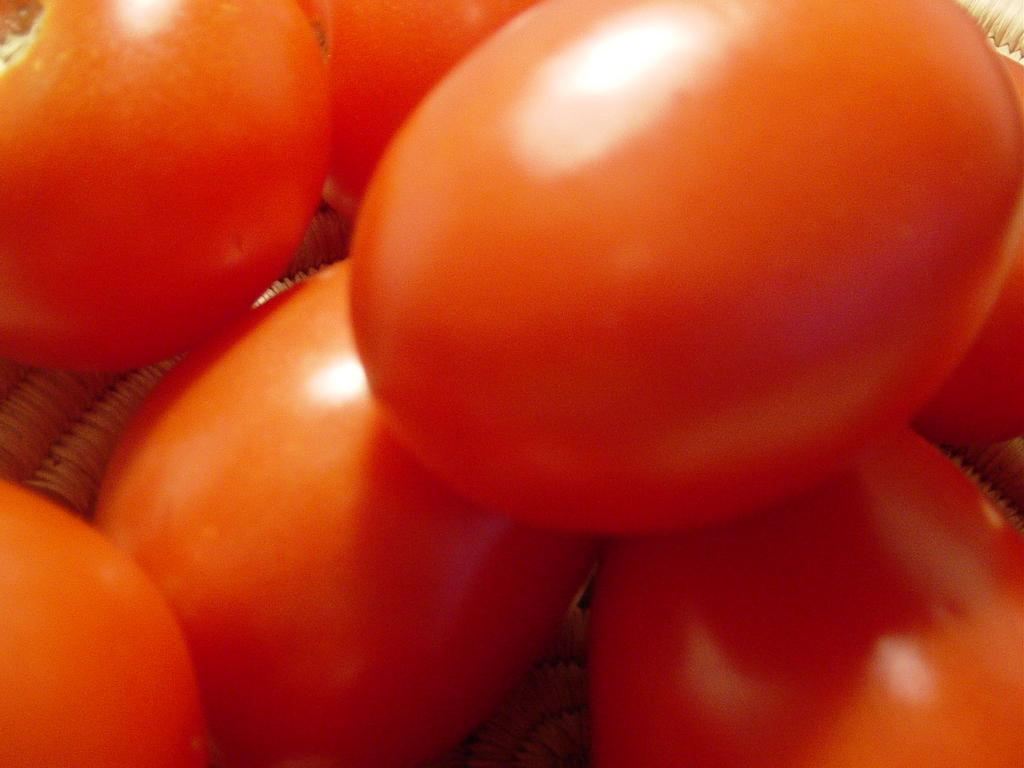
tomatoes

The tomatoes; snipers snipe that they try a little too hard when dressing for comic relief

Depressingly for us, no one actually classifies tomatoes in the above matrix. From reading McGee, they seem to be a cross of Categories Three and Four. They do store starch in their wall tissue, but not as much as, say, apples. The rule of thumb should be to allow them ripen fully on the vine in order to have the fullest flavour[III]. This is sadly at odds with commercial reality. One tip that may help us; store tomatoes at about 10 C in order to maintain their flavour (due to a critical flavour compound, (Z)-3-dexenal, which disappears when chilled).

northcote food market
Northcote Rd. food stall; the future of fruit shopping?

Our story ends well. We took at trip to Northcote Food Market and got some great plum tomatoes; red, meaty and perfect for cooking. Our second attempt at the soup was far more successful. It is taken from Celia Brooks Brown’s “Vegetarian Foodscape”.

Ingredients (for 4)
1.25 kg fresh, ripe tomatoes
1 pint (600 ml) Vegetable stock
30 g Ginger, peeled and chopped
4 garlic cloves, peeled and roughly chopped
1-2 tbsp muscovado sugar (depending on the sweetness of the tomatoes)
Salt and pepper to taste
Chopped parsley to garnish

The sweet, meaty plum walls balance the more acidic (citric and malic) flavours and aromas of the jelly and skin. You don't need to peel. Additionally, don't worry about the loss of nutrients; almost 0% of minerals and about 5% of vitamins are lost during cooking tomatoes. Bring the tomatoes to the boil in the vegetable stock. Leave to simmer for 10 minutes. Add the remaining ingredients and simmer for 20 – 30 minutes. Puree the soup. Pass the whole thing through a sieve and serve.

Second time around, this was a fantastic soup. Really luxurious and smooth. I recommend plenty of pepper.

Sources
[I] Shirley O. Corriher "Cookwise"
[II] Jeffrey Steingarten "The Man Who Ate Everything"
[III] Harold McGee "Food & Cooking"

Note: This blog comes partly inspired by the UK's best food programme; “Full on Food”. Anyone who hasn't had the chance of seeing should watch it.

Technorati Tags:

Sunday, August 14, 2005

End of Term 1: Crispy Pork with Fennel and Mustard Lentils

Crispy Pork Belly with Fennel and Mustard Lentils


OK, the whole “learning to cook by being married to a cook and loitering” thing has always been a serious objective for me. Nevertheless I always thought that the teaching staff (Blanca) lacked a certain amount of dedication and conviction… there was never much structure. This weekend that all changed, I’m fearful of the consequences...

Blanca returned from a week in Spain full of fascist fervour. She directly set to assessing how I had coped in the kitchen during her week away. The “Home Alone” series of blogs was used as documented proof of how I had fared. After all these months of love and care, the blog was turned against me.

So, it seems that there was an invisible hand directing most of my efforts over the past few months. The logic was revealed to me yesterday over a morning coffee…

Term 1 (basic), as this period will forever be known, with some of the following "highlights":
- chopping
- pastry
- creaming method
- fish work
- risotto and plant starch

In the end things were ok; I got a B+ for the whole term. I got special praise for my unashamed geekiness and knife skills. My seasoning, lack of comments and annoying questions require improvement. There was no report card or end of term party (apparently Blanca’s school is working on a bit of a shoestring budget)…

We are now entering Term 2 (intermediate), it will be challenging, with the following highlights:
- soufflé
- paella
- French onion soup
- Genoise
- Pasta making
- Choux pastry
- Sauté cut chicken
- French stew

The Term 3 (advanced) syllabus seems to be a little up in the air, but will contain:
- puffed pastry
- beef Wellington

To celebrate the end of term (and relieve a week old pork belly from its misery), we cooked pork belly and mustard lentils today. Fittingly, this earthy recipe comes from the Books for Cooks vol. 6.

For the pork:
1 tbsp fennel seeds
2 garlic cloves, chopped
1 kg pork belly in one piece, skin on and scored
1 tbsp salt

For the lentils:
1 tbsp olive oil
1 large onion, chopped
4 garlic cloves, sliced
350 g puy lentils
4 tbsp Dijon mustard
salt and pepper

For the salsa:
2 tbsp flat-leaf parsley
2 garlic cloves
Olive oil
salt and pepper

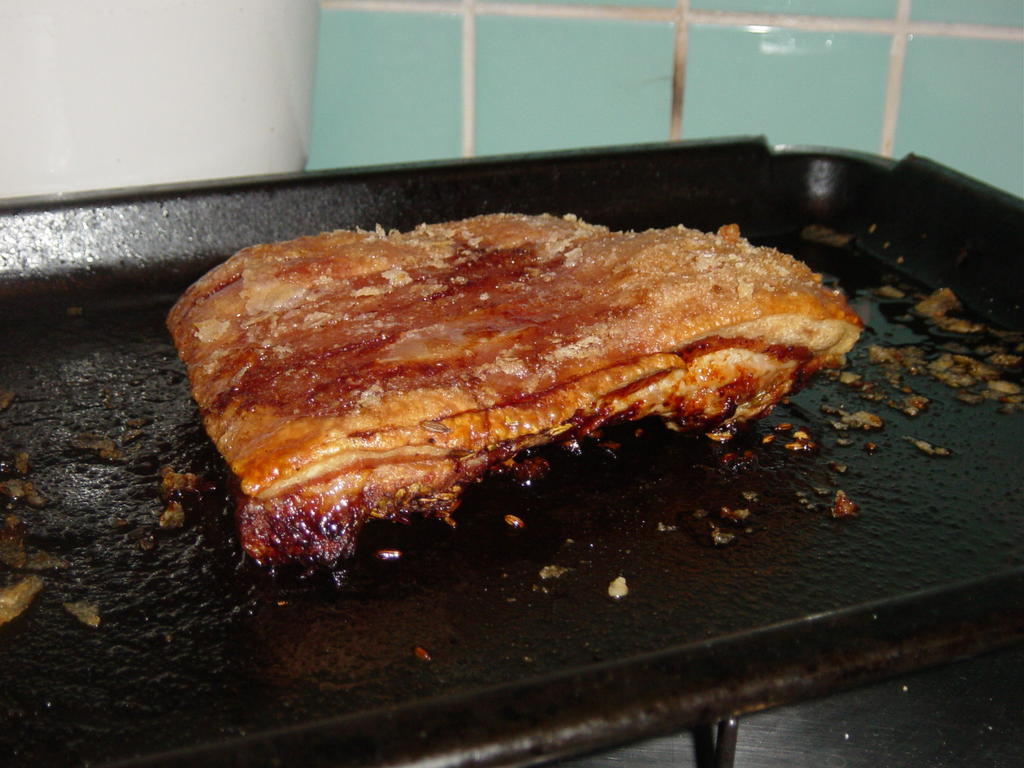
Press the fennel and garlic on the flesh side of the pork. Place in a baking tray, skin side up. Dry the scored side and sprinkle salt evenly over the surface. Leave to stand for half an hour.

Heat the oven to 220 C. Roast the pork for half an hour, turn down to 180 C and bake a further hour and a half. Remove from the oven and let stand for 5 minutes before carving.


Cook the lentil while the pork is in the oven. Warm the oil, add the onion and garlic and stir until the onion has softened (approx 5 mins). Add lentils and cover with boiling water. Put the lid and simmer steadily. Cook for about 50 minutes when the lentils are soft and thick. Add water as it dries out. Stir in mustard and season to taste.


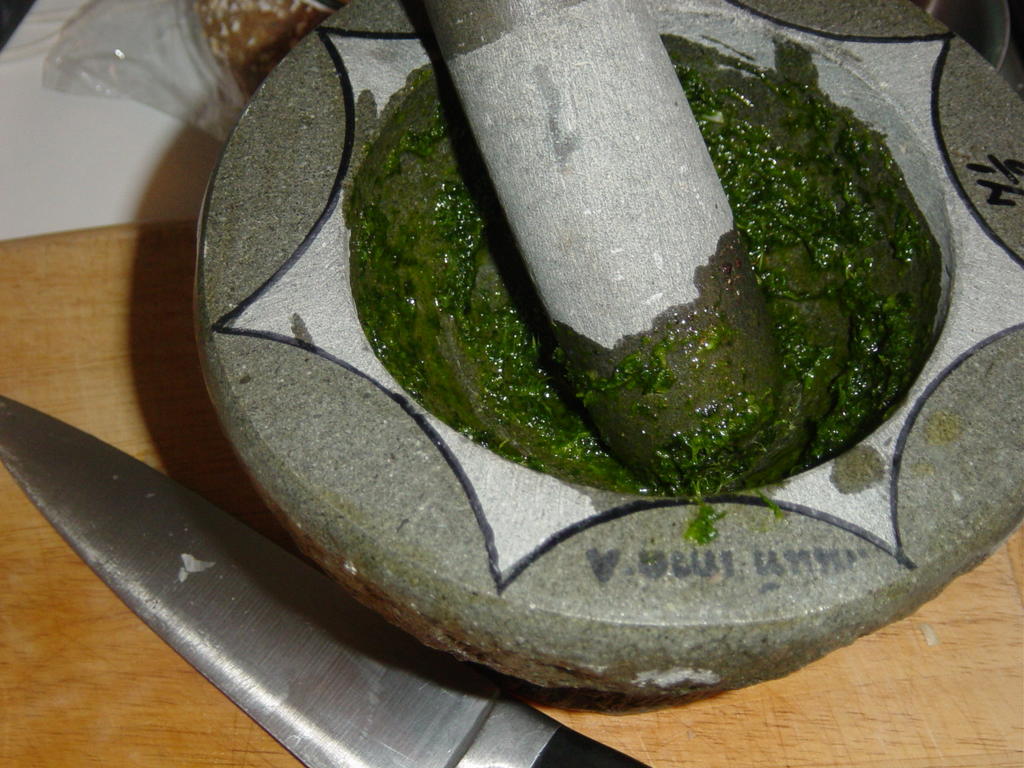
Grind the parsley and garlic in a pestle and mortar. Add the olive oil until it reaches a salsa constituency. Season according to taste.

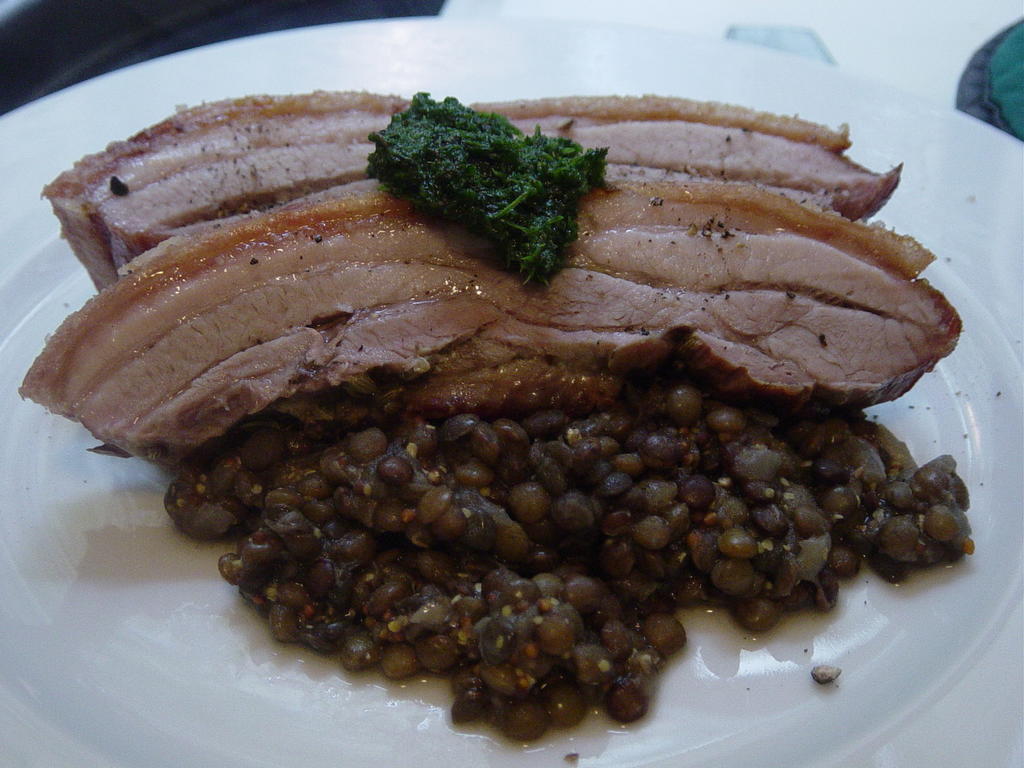
Plate the lentils and lay over strips of pork, topped by parsley salsa.

See you next term…

Technorati Tags: